
Educational quiz app · Ages 5-10
This is what learning looks like


Educational quiz app · Ages 5-10
This is what learning looks like
No nagging required. Keep the learning going after the worksheet, with every question read aloud and Owee guiding each step.
Scan with your phone camera
- Family-friendly
- No ads
- Private
Free Year 1 English worksheets (age 5-6)
Year 1 English builds the foundations of reading and writing for children aged 5 to 6. They use phonics to decode words, learn to read and spell common exception words, and name the letters of the alphabet in order. In writing, they form lower-case and capital letters, leave spaces between words, and begin to punctuate sentences with a capital letter and a full stop.
These sheets cover that ground with the sounds sh, ch and th, CVC words, rhymes, tricky words, alphabet tracing and a capital letters and full stops sheet. Three gentle grammar sheets introduce naming, doing and describing words, which Year 2 goes on to call nouns, verbs and adjectives.
Five- and six-year-olds in Northern Ireland are in Primary 2, and in Scotland roughly Primary 2. In Wales this is Year 1.
Also known as: Scotland P2 · Northern Ireland P2 · Wales Year 1
Spelling listYear 1 common exception words: all 45 words, ready to printPhonics
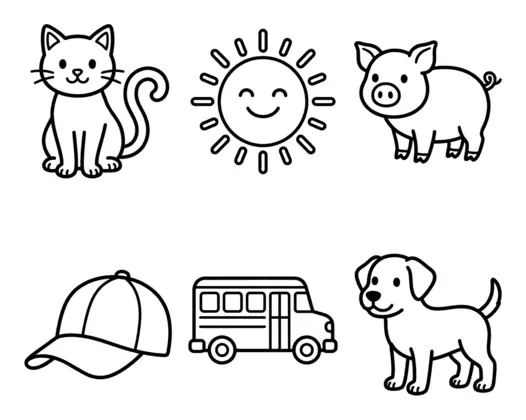
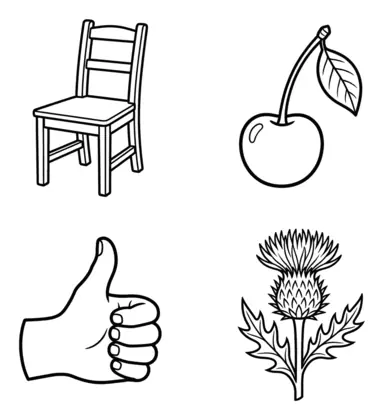
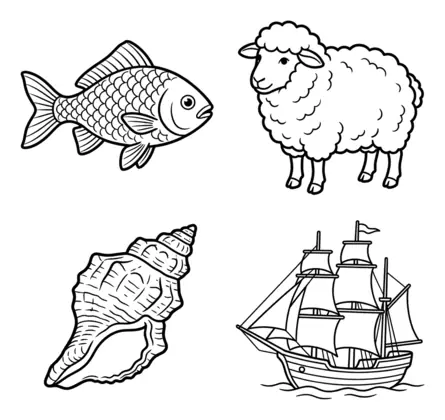
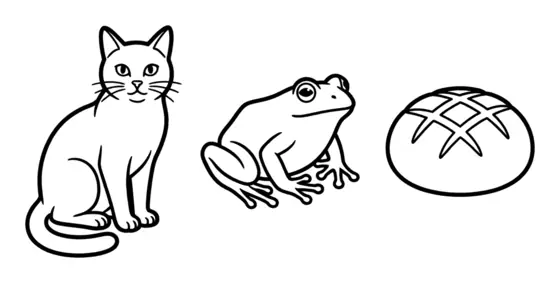
All phonics worksheets →Children learn the sounds that letters and groups of letters make, then blend them to read words and split words into sounds to spell them. In June of Year 1 there is a short phonics screening check.
Handwriting
Children learn to hold a pencil comfortably and form each letter correctly, starting and finishing in the right place, before moving on to joined handwriting.
Spelling
All spelling worksheets →Children learn spelling patterns and rules for each year, such as adding -s or -es, prefixes and suffixes, homophones like there and their, and tricky common exception words.
Vocabulary
Children build a wider range of words by exploring meanings, opposites (antonyms) and words with similar meanings (synonyms), so they can choose words more precisely.
Grammar
All grammar worksheets →Children learn how words and sentences work: naming words (nouns), doing words (verbs), describing words (adjectives and adverbs), joining words (conjunctions) and words for position and time (prepositions).
Punctuation
Children start with capital letters and full stops, then learn question marks, commas, apostrophes and the inverted commas used for speech.
The phonics screening check
Year 1 children in England take the phonics screening check in June. It is a short check of 40 words, each read aloud to a teacher. Some are nonsense words, so children cannot rely on memory and have to sound them out. If your child does not reach the expected standard, they take the check again in Year 2. Practising CVC words and digraphs is a good way to help.
How to practise reading at home
Ask your child to say each sound and then blend them together: c-a-t, cat. Praise the sounding out, not just the right answer. Short, regular practice works better than one long session at the weekend. Reading the school book together most days, with a sheet now and then for variety, is a good balance for this age. If your child guesses from the pictures, cover them and sound out together.
Questions parents ask
What are common exception words?
They are words that do not follow the phonics rules children have learnt so far, such as said, was, friend and school. The national curriculum gives example words for Year 1, and schools teach them alongside phonics so children can read and spell them on sight.
Should my Year 1 child be using full stops?
Yes, it is a Year 1 skill. Children are taught to begin punctuating sentences with a capital letter and a full stop, question mark or exclamation mark, and to use capitals for names and for 'I'. Expect it to come and go for a while.
Do I need to sign up to download?
No. There is no sign-up, login or email. Choose a sheet, then print it or save it as a PDF to keep for later. Each one prints on A4.
Educational quiz app · Ages 5-10
More learning in the Owee app
Owee turns topics like this into quizzes for children aged 5 to 10, and a treehouse grows as they learn. No ads, no chat, no strangers.
- Family-friendly
- No ads
- Private
Educational quiz app · Ages 5-10
More learning in the Owee app
Owee turns topics like this into quizzes for children aged 5 to 10, and a treehouse grows as they learn. No ads, no chat, no strangers.
Scan with your phone camera
- Family-friendly
- No ads
- Private