Educational quiz app · Ages 5-10
This is what learning looks like


Educational quiz app · Ages 5-10
This is what learning looks like
No nagging required. Keep the learning going after the worksheet, with every question read aloud and Owee guiding each step.
Scan with your phone camera
- Family-friendly
- No ads
- Private
English · Colouring and writing worksheet
The 'sh' Sound: Free KS1 Phonics Worksheet
The consonant digraph 'sh' is one of the first two-letter sounds children meet in phonics, usually in Reception, with plenty of practice in Year 1. This free printable gives them a gentle, hands-on way to practise it: four friendly pictures to colour, each with a name that contains the 'sh' sound, followed by four short clues to read and answer by writing the matching word.
Designed for children aged 5 to 7, the worksheet prints neatly onto one sheet of A4. It works equally well at the kitchen table or as a quick, independent activity in a Year 1 or Year 2 classroom.
What your child is learning
‘Spell words by identifying sounds in them and representing the sounds with a letter or letters.’
Reception (EYFS): Writing early learning goal, Department for Education. Source and licence
The 'sh' Sound
Free English worksheet · Ages 5 to 7
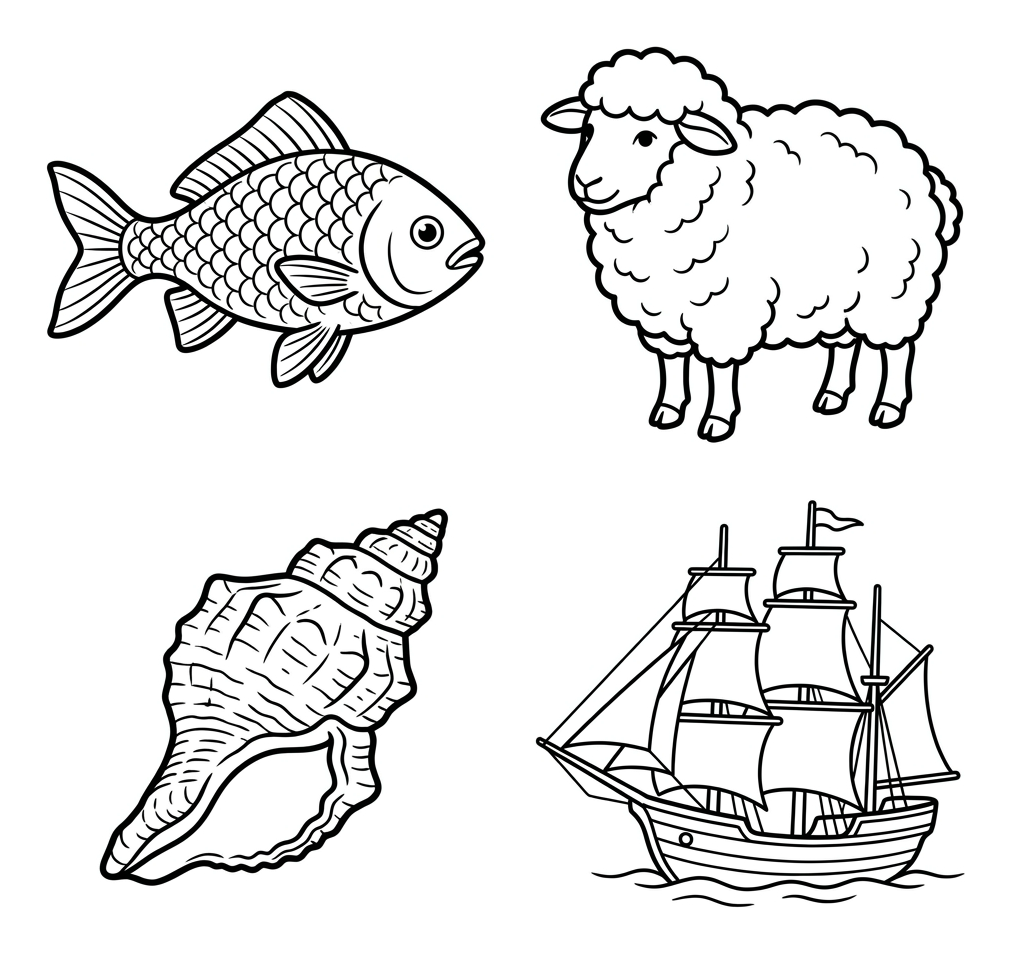
Colour and say
Colour the four pictures. Say each name out loud and listen for sh.
Write the sh words
Read each clue. Write the word on the line. Use the word bank to help you.
It swims and has fins.
You can find it on the beach.
It says baa.
It sails on the sea.
 The 'sh' SoundSheet 6
Answers: The 'sh' Sound
Sheet 6
- It swims and has fins. — fish
- You can find it on the beach. — shell
- It says baa. — sheep
- It sails on the sea. — ship
For grown-ups. Free worksheets and the Owee quiz app at owee.world
Answer key
- It swims and has fins. — fish
- You can find it on the beach. — shell
- It says baa. — sheep
- It sails on the sea. — ship
What is the 'sh' digraph?
A digraph is two letters that work together to make a single sound. In 'sh', the letters 's' and 'h' join to make one sound — /ʃ/ — which is the sound you hear at the start of ship and at the end of fish. It is important that children learn to read the two letters as one sound rather than blending /s/ and /h/ separately, because saying them apart does not produce the correct word. The 'sh' sound appears at the start of words (shop, shell, sheep), in the middle (washing, fishing) and at the end (fish, wish, brush), so it is a high-frequency, high-value sound to secure early.
How to use this worksheet
Begin by saying the 'sh' sound together, encouraging your child to notice how the lips push forward and the air flows out in a long, quiet /ʃ/ — the same sound we make when we ask someone to be quiet. Look at each picture in turn and say its name slowly, listening for the 'sh': fish, shell, sheep, ship. Your child can then colour each one. Once the colouring is finished, support them to write the matching word on the lines provided, sounding out the phonemes as they go: sh-i-p has four letters but only three sounds, and sh-ee-p has three sounds too. The word bank is there as a safety net for children who are still building confidence with spelling; confident spellers can cover it up.
Where 'sh' fits in the phonics journey
Most schools following a systematic synthetic phonics programme introduce 'sh' in Reception, soon after children have learnt the single-letter sounds. It is usually taught alongside the other common consonant digraphs ch, th and ng. Securing 'sh' helps children decode many everyday words, such as she, shop and wish, and is a stepping stone towards reading simple captions and sentences on their own. If your child confuses 'sh' with 'ch' (as in chip and ship), slow the sounds right down and exaggerate the difference — 'ch' is a short, sharp sound, while 'sh' is long and breathy.
Keeping practice positive
At this age, little and often beats long sessions. A few minutes of colouring and word-writing keeps the activity feeling like play rather than a test. Praise the effort of sounding out, not just correct answers, and treat any mistakes as useful information about which sounds still need a little more attention. You can extend the activity by going on a 'sh hunt' around the house or garden, spotting other 'sh' words such as shoe, shirt, brush and dish.
Frequently asked questions
What is the 'sh' digraph in phonics?
'sh' is a consonant digraph — two letters that together make one sound, /ʃ/. It is the sound at the start of 'shop' and the end of 'fish'. Children learn to read the two letters as a single sound rather than blending 's' and 'h' separately.
What age or year do children learn the 'sh' sound?
Most phonics programmes teach the 'sh' sound in Reception (ages 4 to 5), alongside the other consonant digraphs 'ch', 'th' and 'ng'. Children keep practising it in Year 1, when they also learn to spell it in longer words.
What are some words that contain the 'sh' sound?
Common 'sh' words for this age group include ship, shop, shell, sheep, shoe, fish, wish, dish, brush and washing. The sound can appear at the start, middle or end of a word.
How can I help my child who confuses 'sh' and 'ch'?
Slow both sounds right down and exaggerate the difference. 'ch' (as in chip) is a short, sharp sound, while 'sh' (as in ship) is a long, breathy sound — the same one we use to ask for quiet. Practising minimal pairs such as chip and ship side by side helps.
Is this 'sh' worksheet free to print?
Yes. This worksheet is completely free to download and print. It fits on one sheet of A4 and is suitable for home or classroom use with children aged 5 to 7.
Curriculum links
- Reception (EYFS): Writing early learning goal (statutory): 'Spell words by identifying sounds in them and representing the sounds with a letter or letters.'
- English Year 1 Word Reading: 'apply phonic knowledge and skills as the route to decode words'
- English Year 1 Word Reading: 'respond speedily with the correct sound to graphemes (letters or groups of letters) for all 40+ phonemes, including, where applicable, alternative sounds for graphemes'
Quoted word for word from Department for Education documents: the National Curriculum in England, the EYFS framework or the RSHE guidance. Contains public sector information licensed under the Open Government Licence v3.0.
Made by The Owee education team. Updated 13/10/2026. Free to print and share.
More english worksheets
All Reception English worksheets →
Reception–Year 1 · PhonicsSheet 4
CVC Words: Read, Trace and Colour
Reception–Year 1 · PhonicsSheet 23
Rhyming Words
Reception–Year 1 · PhonicsSheet 5
The 'ch' and 'th' Sounds
Years 1–2 · PunctuationSheet 24
Capital Letters and Full Stops

Reception–Year 1 · SpellingSheet 25
Common Exception (Tricky) Words: Trace and Write
Years 1–2 · GrammarSheet 71
Describing Words (Adjectives)
Educational quiz app · Ages 5-10
More learning in the Owee app
Owee turns topics like this into quizzes for children aged 5 to 10, and a treehouse grows as they learn. No ads, no chat, no strangers.
- Family-friendly
- No ads
- Private
Educational quiz app · Ages 5-10
More learning in the Owee app
Owee turns topics like this into quizzes for children aged 5 to 10, and a treehouse grows as they learn. No ads, no chat, no strangers.
Scan with your phone camera
- Family-friendly
- No ads
- Private