Educational quiz app · Ages 5-10
This is what learning looks like


Educational quiz app · Ages 5-10
This is what learning looks like
No nagging required. Keep the learning going after the worksheet, with every question read aloud and Owee guiding each step.
Scan with your phone camera
- Family-friendly
- No ads
- Private
English · Colouring and writing worksheet
Opposite Words (Antonyms) Free KS1 Worksheet
Opposites, or antonyms, are one of the first ways young children begin to explore how words relate to one another. Pairs such as big and small, tall and short and happy and sad are easy to picture, which makes them an ideal starting point for vocabulary work in Reception and Year 1.
This free, one-page worksheet pairs gentle colouring with simple writing. Children colour three picture pairs and then write the opposites of five words: the three shown in the picture plus hot and up, which they have to picture for themselves. This reinforces both the meaning of the vocabulary and early spelling. It prints cleanly to a single sheet of A4, so it is ready for the classroom, home learning or a quiet rainy afternoon.
What your child is learning
‘discussing word meanings, linking new meanings to those already known’
Year 1 English: Reading – comprehension, National Curriculum in England. Source and licence
Opposite Words
Free English worksheet · Ages 5 to 7
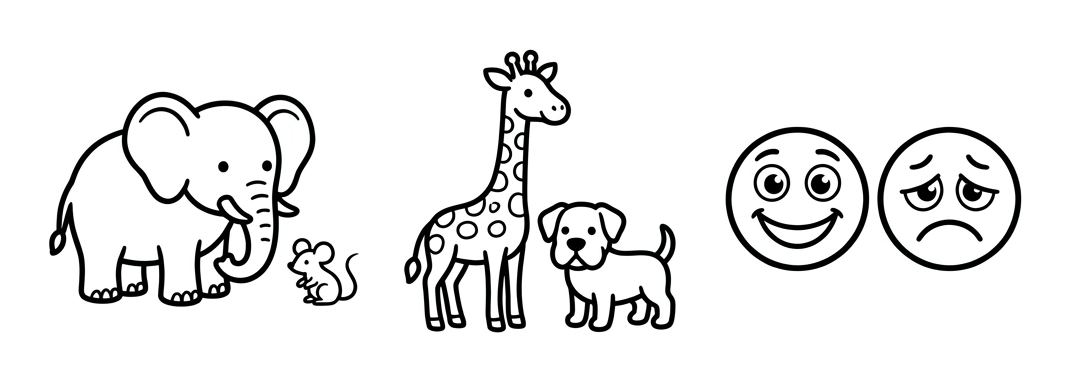
Colour the opposite pairs
Colour each pair. Say why they are opposites: the elephant is big and the mouse is small.
Write the opposite word
Write the opposite word on the line. Use the word bank to help you spell it.
The opposite of big is __.
The opposite of tall is __.
The opposite of happy is __.
The opposite of hot is __.
The opposite of up is __.
 Opposite WordsSheet 26
Answers: Opposite Words
Sheet 26
- The opposite of big is small.
- The opposite of tall is short.
- The opposite of happy is sad (unhappy is also right).
- The opposite of hot is cold.
- The opposite of up is down.
For grown-ups. Free worksheets and the Owee quiz app at owee.world
Answer key
- The opposite of big is small.
- The opposite of tall is short.
- The opposite of happy is sad (unhappy is also right).
- The opposite of hot is cold.
- The opposite of up is down.
What are opposites (antonyms)?
An antonym is a word that means the reverse of another word. In Key Stage 1, opposites are usually introduced through concrete, easily pictured pairs such as big and small, tall and short, hot and cold, up and down, and happy and sad. Understanding opposites helps children grasp that words carry meaning in relation to one another, which is an important step in building a flexible and precise vocabulary. The word antonym itself is not expected at this age; the focus is simply on recognising and saying which word means the reverse.
How this worksheet supports the curriculum
In Year 1, children are taught to discuss word meanings and link new words to ones they already know, and opposites are one of the clearest links there is. Year 1 grammar also covers how the prefix un- changes a word’s meaning (kind, unkind). It is worth showing your child that unhappy is another opposite of happy, so both answers are right. The three picture pairs (big and small, tall and short, happy and sad) make the first answers easy to see, while hot and up ask children to think of the opposite without a picture.
Ways to use it at home or in class
Before writing, talk through each picture together: which animal is big and which is small? Encourage full sentences such as "The elephant is big and the mouse is small." You can extend the activity by playing a quick spoken opposites game, where you say a word and the child gives the opposite, or by hunting for opposites around the room (open and shut, light and dark, full and empty). For children who find the spelling tricky, the word bank on the sheet offers a gentle prompt so the task stays about understanding meaning rather than getting stuck on letters.
Building vocabulary beyond opposites
Opposites are a natural gateway to wider word work. Once children are confident, you can introduce the idea that some words have several near-opposites (for example, big can pair with small, tiny or little) and that opposites often appear in stories to create contrast. Reading picture books aloud and pausing to ask "what would the opposite be?" keeps vocabulary growing in a meaningful context. Regular, low-pressure practice like this lays the groundwork for Year 6, when children learn the terms synonym and antonym.
Frequently asked questions
What is an antonym for KS1 children?
An antonym is simply an opposite word. For children aged 5 to 7, the easiest examples are picture pairs such as big and small, tall and short, and happy and sad. The term antonym is not required at this age; the focus is on recognising and saying the opposite word.
What age is this opposites worksheet for?
It is designed for children aged 5 to 7, in Year 1 and Year 2 (KS1). Confident Reception children can do it with an adult reading the words aloud. The colouring suits younger or less confident writers, while the writing lines and word bank stretch children who are ready to record their own answers.
Is this opposites worksheet free to print?
Yes. The worksheet is completely free and prints to a single A4 page in black and white, so it is ready to use at home or in the classroom without any sign-up.
What opposite word pairs does it cover?
The picture shows three clear pairs: big and small (elephant and mouse), tall and short (giraffe and dog), and happy and sad (two faces). The writing task adds hot and cold, and up and down. A word bank is included to help with spelling.
How can I help my child learn opposites?
Talk through each picture in full sentences, play a quick spoken opposites game (you say a word, they give the opposite), and look for opposites around the home such as open and shut or light and dark. Short, regular practice works best at this age.
Curriculum links
- Year 1 English: Reading – comprehension (statutory): 'discussing word meanings, linking new meanings to those already known'
Quoted word for word from Department for Education documents: the National Curriculum in England, the EYFS framework or the RSHE guidance. Contains public sector information licensed under the Open Government Licence v3.0.
Made by The Owee education team. Updated 13/10/2026. Free to print and share.
More english worksheets
All Year 1 English worksheets →
Years 5–6 · VocabularySheet 179
Synonyms and Antonyms: Word Power
Years 1–2 · PunctuationSheet 24
Capital Letters and Full Stops
Reception–Year 1 · SpellingSheet 25
Common Exception (Tricky) Words: Trace and Write
Reception–Year 1 · PhonicsSheet 4
CVC Words: Read, Trace and Colour
Years 1–2 · GrammarSheet 71
Describing Words (Adjectives)
Years 1–2 · GrammarSheet 72
Doing Words (Verbs)
Educational quiz app · Ages 5-10
More learning in the Owee app
Owee turns topics like this into quizzes for children aged 5 to 10, and a treehouse grows as they learn. No ads, no chat, no strangers.
- Family-friendly
- No ads
- Private
Educational quiz app · Ages 5-10
More learning in the Owee app
Owee turns topics like this into quizzes for children aged 5 to 10, and a treehouse grows as they learn. No ads, no chat, no strangers.
Scan with your phone camera
- Family-friendly
- No ads
- Private