Educational quiz app · Ages 5-10
This is what learning looks like


Educational quiz app · Ages 5-10
This is what learning looks like
No nagging required. Keep the learning going after the worksheet, with every question read aloud and Owee guiding each step.
Scan with your phone camera
- Family-friendly
- No ads
- Private
English · Colouring and tick worksheet
'ch' and 'th' Sounds: Free KS1 Phonics Worksheet
This free printable worksheet gives Year 1 children focused practice with two of the trickiest consonant digraphs in early phonics: 'ch' and 'th'. A digraph is simply two letters that work together to make a single sound, and recognising them on sight is an important step towards confident, fluent reading.
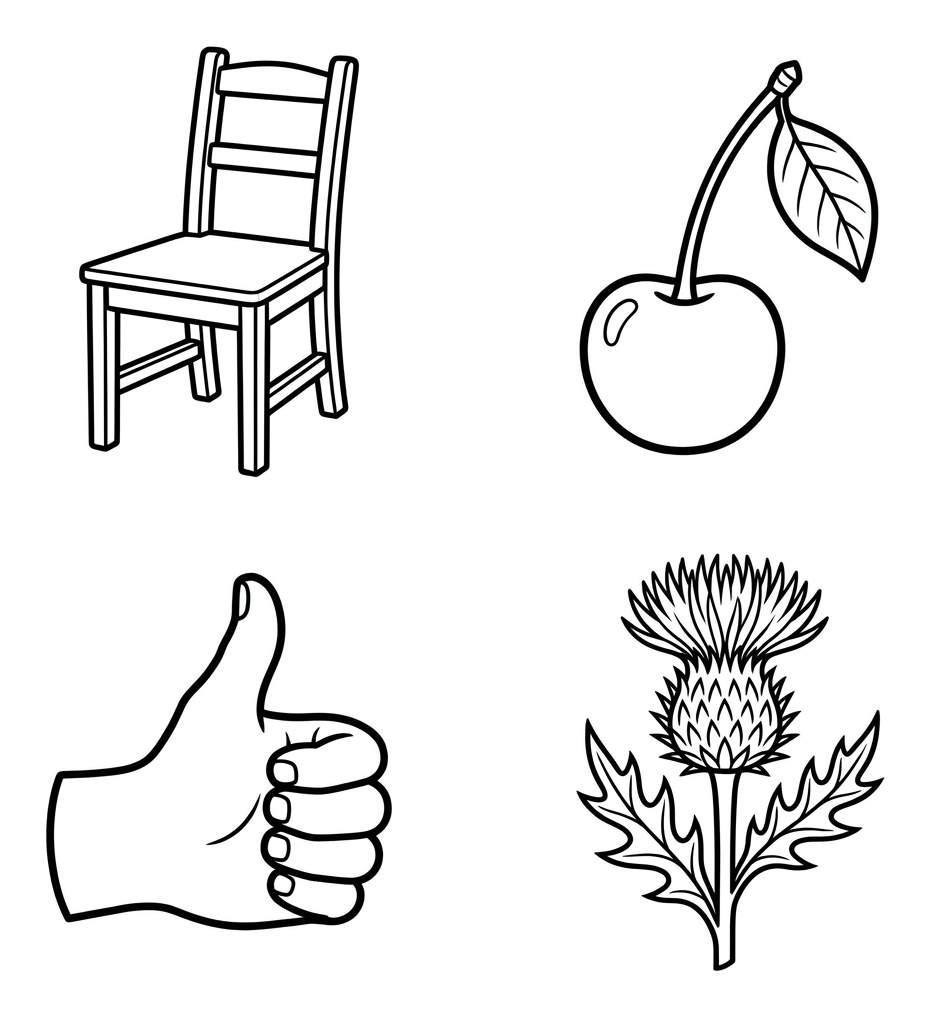
Children colour four pictures (a chair, a cherry, a thumb and a thistle) and say each name aloud. Then they listen to the first sound of each word and write ch or th to finish it. Writing the two letters, rather than just ticking, links the sound they hear to the spelling they will need. The sheet prints on one A4 page and takes about ten minutes.
What your child is learning
‘Say a sound for each letter in the alphabet and at least 10 digraphs.’
Reception (EYFS): Word Reading early learning goal, Department for Education. Source and licence
The 'ch' and 'th' Sounds
Free English worksheet · Ages 5 to 7
Colour and say
Colour the four pictures. Say the name of each one out loud: chair, cherry, thumb, thistle.
ch or th?
Say each word. Listen to the first sound. Write ch or th to finish the word.
__air
__umb
__erry
__istle
 The 'ch' and 'th' SoundsSheet 5
Answers: The 'ch' and 'th' Sounds
Sheet 5
- chair
- thumb
- cherry
- thistle
For grown-ups. Free worksheets and the Owee quiz app at owee.world
Answer key
- chair
- thumb
- cherry
- thistle
What are the 'ch' and 'th' digraphs?
A digraph is two letters that together represent one phoneme (a single unit of sound). In 'ch' the c and h combine to make the sound you hear at the start of chair, cherry and chip. In 'th' the t and h combine to make the sound you hear at the start of thumb, thistle and thirteen. Most school phonics programmes teach both in Reception and keep practising them in Year 1. The 'th' sound is worth a special mention because it actually has two pronunciations: a 'voiced' version (as in this and that) and an 'unvoiced' version (as in thumb and thin). For this worksheet the focus is simply on spotting the spelling pattern, so children do not need to distinguish between the two.
How to use this worksheet at home or in class
Print the sheet and read each picture name aloud together, sounding it out slowly so the child can hear the very first sound: ch-ch-chair, th-th-thumb. Encourage the child to say the digraph sound rather than the individual letter names. They can colour the pictures first to settle in, then fill in the missing letters one word at a time. If a child writes c or t on its own, say the word again and ask, ‘Is that one sound or two letters?’ — the answer is one sound, written with two letters. A common mix-up is between 'ch' and 'sh', so it can help to hold a hand in front of the mouth: ‘ch’ is one short puff of air, while ‘shhh’ can keep going.
Why digraphs matter for early reading
Once children can blend single letter-sounds, digraphs are often the next hurdle. Without recognising that 'ch' and 'th' are single sounds, a child may try to read chip as 'c-h-i-p' and become stuck. Teaching digraphs as a single, recognisable unit prevents this and supports the systematic synthetic phonics approach used across English schools. Knowing the common digraphs opens up a large number of everyday words, such as chip, much, this and with. Completing words with the right pair of letters, as in this worksheet, reinforces that letters can team up, an idea children will revisit with 'sh', 'ng', 'qu' and other digraphs and trigraphs.
Extending the activity
After completing the sheet, turn it into a quick word hunt. Ask the child to find more things around the room that begin with 'ch' (a chair, a chest, a chin) or 'th' (a thumb, a thread, the number three). You could also gather a few household objects or picture cards and ask the child to physically sort them into a 'ch' pile and a 'th' pile. For children ready for more, try listening for the digraphs in the middle or at the end of words, such as teacher, bath and tooth. Short, playful repetition over several days helps these sounds become automatic.
Frequently asked questions
What is a digraph in phonics?
A digraph is two letters that together make one sound. In 'chair' the letters c and h make a single 'ch' sound, and in 'thumb' the letters t and h make a single 'th' sound. Recognising digraphs as one sound helps children decode words accurately.
When do children learn the 'ch' and 'th' sounds?
Most school phonics programmes teach 'ch' and 'th' in Reception (ages 4 to 5), and children keep practising them in Year 1. By the end of Reception, children are expected to say a sound for at least 10 digraphs.
Is this worksheet suitable for Year 1?
Yes. It suits children at the end of Reception and in Year 1. It supports the Year 1 word reading objective of applying phonic knowledge to decode words, and the Reception goal of saying a sound for at least 10 digraphs.
Why does 'th' sometimes sound different?
The 'th' digraph has two pronunciations: a voiced sound as in 'this' and 'that', and an unvoiced sound as in 'thumb' and 'thin'. Children do not need to tell them apart for this worksheet; the focus is simply on spotting the 'th' spelling pattern.
How can I help my child practise digraphs at home?
Say words slowly and stretch out the first sound, then go on a word hunt for objects starting with 'ch' or 'th'. Sorting picture cards or household items into two piles by their opening sound is a simple, effective way to reinforce the learning.
Curriculum links
- Reception (EYFS): Word Reading early learning goal (statutory): 'Say a sound for each letter in the alphabet and at least 10 digraphs.'
- English, Year 1 Word reading: 'apply phonic knowledge and skills as the route to decode words'
- English, Year 1 Word reading: 'respond speedily with the correct sound to graphemes (letters or groups of letters) for all 40+ phonemes, including, where applicable, alternative sounds for graphemes'
Quoted word for word from Department for Education documents: the National Curriculum in England, the EYFS framework or the RSHE guidance. Contains public sector information licensed under the Open Government Licence v3.0.
Made by The Owee education team. Updated 13/10/2026. Free to print and share.
More english worksheets
All Reception English worksheets →
Reception–Year 1 · PhonicsSheet 4
CVC Words: Read, Trace and Colour
Reception–Year 1 · PhonicsSheet 23
Rhyming Words
Reception–Year 1 · PhonicsSheet 6
The 'sh' Sound
Years 1–2 · PunctuationSheet 24
Capital Letters and Full Stops

Reception–Year 1 · SpellingSheet 25
Common Exception (Tricky) Words: Trace and Write
Years 1–2 · GrammarSheet 71
Describing Words (Adjectives)
Educational quiz app · Ages 5-10
More learning in the Owee app
Owee turns topics like this into quizzes for children aged 5 to 10, and a treehouse grows as they learn. No ads, no chat, no strangers.
- Family-friendly
- No ads
- Private
Educational quiz app · Ages 5-10
More learning in the Owee app
Owee turns topics like this into quizzes for children aged 5 to 10, and a treehouse grows as they learn. No ads, no chat, no strangers.
Scan with your phone camera
- Family-friendly
- No ads
- Private