Educational quiz app · Ages 5-10
This is what learning looks like


Educational quiz app · Ages 5-10
This is what learning looks like
No nagging required. Keep the learning going after the worksheet, with every question read aloud and Owee guiding each step.
Scan with your phone camera
- Family-friendly
- No ads
- Private
English · Writing and colouring worksheet
Rhyming Words Worksheet: Free KS1 Phonics Printable
Rhyming is one of the very first listening skills that helps a child get ready to read. When children can hear that cat, hat and mat end in the same sound, they are beginning to break words into the smaller chunks that phonics relies on. This free worksheet asks the child to look at three friendly pictures and write a word that rhymes with each one.
Designed for Years 1 and 2 (ages 5 to 7), it prints neatly onto one A4 page. There is a word bank for children who need a starting point, and the picture to colour once the writing is done. Any real word that rhymes is a right answer, so the sheet rewards listening rather than guessing one ‘correct’ word.
What your child is learning
‘learning to appreciate rhymes and poems, and to recite some by heart’
Year 1 English: Reading – comprehension, National Curriculum in England. Source and licence
Rhyming Words
Free English worksheet · Ages 5 to 7
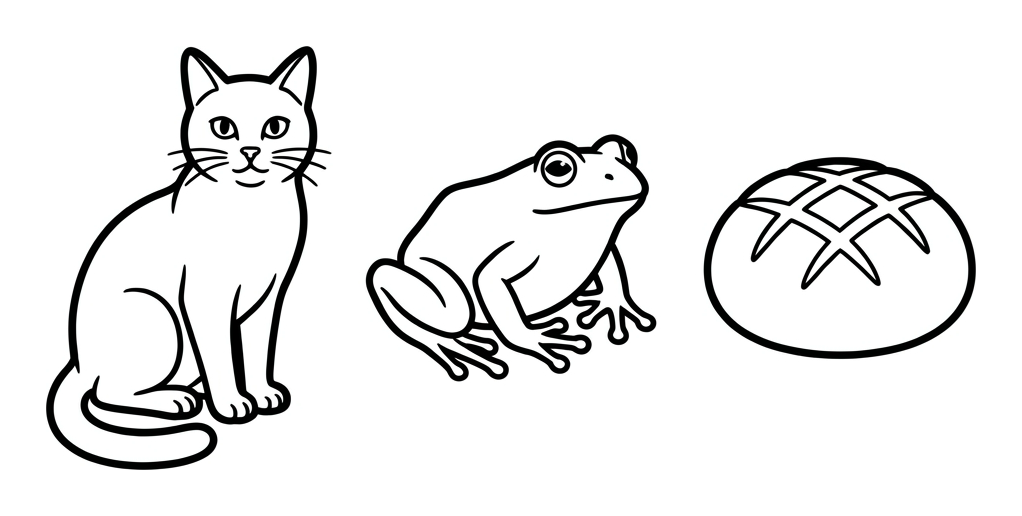
Write a rhyming word
Say the name of each picture. Write a word that rhymes with it. Use the word bank or think of your own.
Write a word that rhymes with CAT.
Write a word that rhymes with FROG.
Write a word that rhymes with BUN.
Colour the picture
Colour the cat, the frog and the bun. Say your rhyming words again as you colour.
 Rhyming WordsSheet 23
Answers: Rhyming Words
Sheet 23
- Write a word that rhymes with CAT. — Any rhyme, such as hat, mat, bat, sat, rat or pat
- Write a word that rhymes with FROG. — Any rhyme, such as dog, log, jog or bog
- Write a word that rhymes with BUN. — Any rhyme, such as sun, fun, run, nun or spun
For grown-ups. Free worksheets and the Owee quiz app at owee.world
Answer key
- Write a word that rhymes with CAT. — Any rhyme, such as hat, mat, bat, sat, rat or pat
- Write a word that rhymes with FROG. — Any rhyme, such as dog, log, jog or bog
- Write a word that rhymes with BUN. — Any rhyme, such as sun, fun, run, nun or spun
What this rhyming worksheet teaches
This activity focuses on generating rhymes: rather than just spotting words that sound the same, the child has to think of a brand-new word that ends in the same sound. That is a more demanding step and a strong sign that a child is hearing the 'rime' (the end part) of a word clearly. Each picture comes from a tidy, familiar rhyme family. A cat rhymes with hat, mat, bat, sat, rat and pat. A frog rhymes with dog, log, jog and bog. A bun rhymes with sun, fun, run, nun and spun. Because the spellings in these families are mostly regular, children can usually hear the rhyme and have a fair chance of spelling it too, which keeps the task encouraging rather than frustrating.
Why rhyme matters before reading
Phonological awareness, the ability to hear and play with the sounds in spoken language, is closely linked to how smoothly a child learns to read. Rhyme is an early, playful part of that awareness. When a child notices that two words finish in the same way, they are paying attention to sound rather than meaning, which is exactly the mindset phonics teaching builds on. Nursery rhymes, songs and rhyming picture books all feed this skill long before formal lessons begin, so a short written task like this one simply makes the learning visible and gives you a chance to talk about the sounds together.
How to use it at home or in class
Say each pictured word aloud with the child first, stretching out the ending: 'caaat'. Ask them to suggest several rhyming words before choosing one to write, because thinking of three or four out loud is where the real learning happens. Accept any correctly spelled real word that rhymes; there is no single right answer. For children who are still finding letter formation tricky, you might let them say the word while you scribe, then have them copy it. Once the writing is finished, the colouring picture gives a gentle reward and a natural moment to revisit the words: 'You coloured the frog green, can you remember a word that rhymes with frog?'
Extending the activity
To stretch a confident child, ask them to build a whole 'rhyming string' for each picture and count how many words they can find, or to make up a silly two-line rhyme such as 'The cat sat on the mat'. Some children enjoy sorting words that look the same but do not rhyme, which sharpens listening. If a child offers a word that rhymes but is spelled in an unexpected way (for example one, which rhymes with bun, or won), praise the listening first, then show them how it is spelled. Rhymes are about sounds, so they do not always share the same letters. The aim at this stage is confident, happy sound play rather than perfect spelling.
Frequently asked questions
What rhymes with cat, frog and bun?
Cat rhymes with hat, mat, bat, sat, rat and pat. Frog rhymes with dog, log, jog and bog. Bun rhymes with sun, fun, run, nun and spun. Any correctly spelled real word that ends in the same sound counts.
What age is this rhyming worksheet for?
It is aimed at children aged 5 to 7, which is Years 1 and 2 in KS1. Older children working on early phonics or younger children with adult support can also enjoy it.
Is this rhyming words worksheet free to print?
Yes. The worksheet is completely free and prints onto a single A4 page, with space to write rhyming words and a picture to colour in afterwards.
How do I teach my child about rhyming words?
Say words aloud and stretch the endings so the child hears the matching sound, share nursery rhymes and rhyming books, and play games where you take turns adding to a rhyming string. Generating new rhymes, as in this worksheet, is a useful next step.
What is the difference between rhyming and alliteration?
Rhyming words share the same end sound, such as cat and hat. Alliteration is when words share the same beginning sound, such as big blue ball. Both help children tune in to the sounds in words before reading.
Curriculum links
- Year 1 English: Reading – comprehension (statutory): 'learning to appreciate rhymes and poems, and to recite some by heart'
- English, Year 1 Reading (word reading): 'apply phonic knowledge and skills as the route to decode words'
Quoted word for word from Department for Education documents: the National Curriculum in England, the EYFS framework or the RSHE guidance. Contains public sector information licensed under the Open Government Licence v3.0.
Made by The Owee education team. Updated 13/10/2026. Free to print and share.
More english worksheets
All Year 1 English worksheets →
Reception–Year 1 · PhonicsSheet 4
CVC Words: Read, Trace and Colour
Reception–Year 1 · PhonicsSheet 5
The 'ch' and 'th' Sounds
Reception–Year 1 · PhonicsSheet 6
The 'sh' Sound
Years 1–2 · PunctuationSheet 24
Capital Letters and Full Stops
Reception–Year 1 · SpellingSheet 25
Common Exception (Tricky) Words: Trace and Write
Years 1–2 · GrammarSheet 71
Describing Words (Adjectives)
Educational quiz app · Ages 5-10
More learning in the Owee app
Owee turns topics like this into quizzes for children aged 5 to 10, and a treehouse grows as they learn. No ads, no chat, no strangers.
- Family-friendly
- No ads
- Private
Educational quiz app · Ages 5-10
More learning in the Owee app
Owee turns topics like this into quizzes for children aged 5 to 10, and a treehouse grows as they learn. No ads, no chat, no strangers.
Scan with your phone camera
- Family-friendly
- No ads
- Private