Educational quiz app · Ages 5-10
This is what learning looks like


Educational quiz app · Ages 5-10
This is what learning looks like
No nagging required. Keep the learning going after the worksheet, with every question read aloud and Owee guiding each step.
Scan with your phone camera
- Family-friendly
- No ads
- Private
English · Suffix word-building worksheet
Suffixes Worksheet: -ful, -less and -ly (Free KS2)
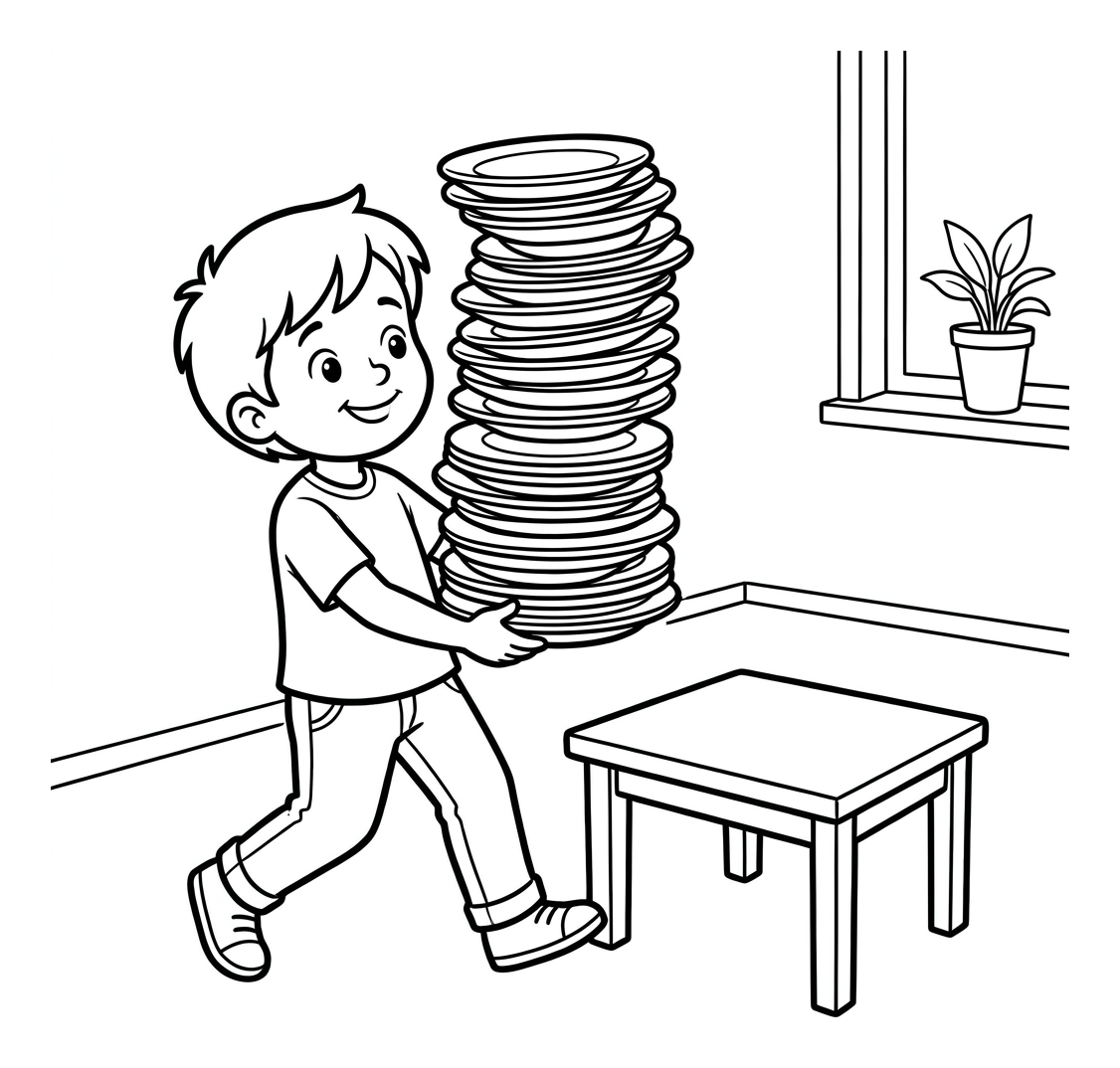
This free printable worksheet helps children in Years 3 and 4 build new words by adding the suffixes -ful, -less, -ly and -ness to root words. The colourable picture of a child carefully carrying a wobbling stack of plates gives a memorable hook for the words careful, careless and carefully, so children can see how one root word can grow in several directions.
It is designed to print neatly onto one A4 page. Children write the new words on the lines, tick the sentences that use a suffix correctly, then colour the illustration. The notes below explain the spelling rules involved and link directly to the National Curriculum so you can see exactly what is being practised.
What your child is learning
‘add suffixes to spell longer words including –ment, –ness, –ful, –less, –ly’
Year 2 English: Writing – transcription (spelling, Appendix 1), National Curriculum in England. Source and licence

Suffixes: -ful, -less and -ly
Free English worksheet · Ages 7 to 9
Build the new word
Add the suffix to the root word. Write the new word on the line. Watch out: -ful has one l, and some words change y to i or -le to -ly.
care + ful
careful + ly
hope + less
kind + ness
beauty + ful
gentle + ly
happy + ly
Tick the correct sentence
Tick the box if the suffix word is spelt correctly.
- He carried the plates carefully so they did not fall.
- He was carefull not to drop them.
- Dropping a plate would be careless.
- He felt hopeful that the plates would not fall.
- He smiled happyly when he got to the table.
- It was a great kindless to help him.
 Suffixes: -ful, -less and -lySheet 77
Answers: Suffixes: -ful, -less and -ly
Sheet 77
- care + ful — careful
- careful + ly — carefully
- hope + less — hopeless
- kind + ness — kindness
- beauty + ful — beautiful
- gentle + ly — gently
- happy + ly — happily
- He carried the plates carefully so they did not fall. — Tick
- He was carefull not to drop them. — No tick (careful has one l)
- Dropping a plate would be careless. — Tick
- He felt hopeful that the plates would not fall. — Tick
- He smiled happyly when he got to the table. — No tick (happily: y changes to i)
- It was a great kindless to help him. — No tick (kindness)
For grown-ups. Free worksheets and the Owee quiz app at owee.world
Answer key
- care + ful — careful
- careful + ly — carefully
- hope + less — hopeless
- kind + ness — kindness
- beauty + ful — beautiful
- gentle + ly — gently
- happy + ly — happily
- He carried the plates carefully so they did not fall. — Tick
- He was carefull not to drop them. — No tick (careful has one l)
- Dropping a plate would be careless. — Tick
- He felt hopeful that the plates would not fall. — Tick
- He smiled happyly when he got to the table. — No tick (happily: y changes to i)
- It was a great kindless to help him. — No tick (kindness)
What a suffix does and why -ful and -less make opposites
A suffix is a group of letters added to the end of a root word to change its meaning or its word class. The suffix -ful usually means 'full of' (a careful person is full of care; a helpful friend is full of help), while -less means 'without' (a careless person acts without care; a helpless kitten is without help). Because they pull in opposite directions, -ful and -less frequently create antonyms from the very same root: hope becomes hopeful or hopeless, use becomes useful or useless, fear becomes fearful or fearless. Pointing this pattern out helps children remember both suffixes at once and quietly builds their understanding of opposites.
How -ly forms adverbs and -ness forms nouns
The suffix -ly most often turns an adjective into an adverb, which is a word that describes how something is done: quick becomes quickly, careful becomes carefully, sad becomes sadly. Encourage children to ask 'How did they do it?' to check that an -ly word is working as an adverb. The suffix -ness turns an adjective into an abstract noun, a naming word for a quality you cannot touch: kind becomes kindness, dark becomes darkness, happy becomes happiness. Talking about word class (adjective, adverb, noun) as the words change gives children the vocabulary they will need throughout KS2 grammar lessons.
Spelling rules to watch when adding these suffixes
Most of the time these suffixes are simply added to the root with no change: care + ful = careful, care + less = careless, slow + ly = slowly. There are a few reliable adjustments worth modelling. When a root of more than one syllable ends in a consonant followed by y, the y changes to i before -ful, -ness and -ly: beauty becomes beautiful, happy becomes happiness and happily. One-syllable words keep their y, as in shyness. When -ly is added to a word ending in -le, the -le is replaced by -ly: gentle becomes gently, simple becomes simply. Note too that -ful as a suffix has only one l, even though the word 'full' has two; this is a very common spelling slip for this age group.
How to use this worksheet at home or in class
Read the worksheet through together first and say each new word aloud so children hear the extra syllable the suffix adds. For the writing task, let them build the words by saying 'root word plus suffix' before they write, which slows them down and reduces errors. There is no word bank, so the spelling has to come from the rules. The tick task has three correct sentences and three with a typical slip (carefull, happyly, kindless); ask your child to explain what is wrong and correct it, which turns proofreading into reasoning. Finish with the colouring, which gives a calm, low-pressure end to the activity and a chance to revisit the careful/careless/carefully word family one more time. The sheet works well as morning revision, homework, or a quick assessment of which suffix rules need more practice.
Frequently asked questions
What suffixes do children learn in Years 3 and 4?
Children first learn -ment, -ness, -ful, -less and -ly in Year 2. In Years 3 and 4 they revisit -ly to form adverbs, with its spelling rules: y changes to i (happily), -le becomes -ly (gently) and -ic becomes -ically (basically). They also meet new suffixes such as -ation and -ous.
What is the difference between -ful and -less?
The suffix -ful means 'full of' (careful means full of care) and -less means 'without' (careless means without care). Because they mean opposite things, adding them to the same root word often creates a pair of opposites, such as hopeful and hopeless.
Does the suffix -ful have one l or two?
As a suffix, -ful is always spelt with a single l, even though the separate word 'full' has two. So we write careful, helpful and beautiful, not carefull. This is one of the most common spelling errors at this age, so it is worth pointing out directly.
What does the suffix -ly do to a word?
The suffix -ly usually turns an adjective into an adverb, a word that describes how something is done, for example quick to quickly and careful to carefully. When a root word ends in -le, the -le is replaced by -ly, as in gentle to gently.
Is this suffixes worksheet free to print?
Yes. This worksheet is completely free to download and print, designed for a single A4 page. You are welcome to use it at home or in the classroom for ages 7 to 9 (Years 3 and 4).
Curriculum links
- Year 2 English: Writing – transcription (spelling, Appendix 1) (statutory): 'add suffixes to spell longer words including –ment, –ness, –ful, –less, –ly'
Quoted word for word from Department for Education documents: the National Curriculum in England, the EYFS framework or the RSHE guidance. Contains public sector information licensed under the Open Government Licence v3.0.
Made by The Owee education team. Updated 13/10/2026. Free to print and share.
More english worksheets
All Year 2 English worksheets →
Reception–Year 1 · SpellingSheet 25
Common Exception (Tricky) Words: Trace and Write
Years 2–3 · SpellingSheet 75
Homophones: there, their and they're
Years 2–3 · SpellingSheet 76
Plurals: -s, -es and Changing y to i
Years 3–4 · SpellingSheet 111
Prefixes: un-, dis-, mis- and re-
Years 3–4 · GrammarSheet 109
Adverbs: How, When and Where
Years 3–4 · Dictionary skillsSheet 108
Alphabetical Order: Using a Dictionary
Educational quiz app · Ages 5-10
More learning in the Owee app
Owee turns topics like this into quizzes for children aged 5 to 10, and a treehouse grows as they learn. No ads, no chat, no strangers.
- Family-friendly
- No ads
- Private
Educational quiz app · Ages 5-10
More learning in the Owee app
Owee turns topics like this into quizzes for children aged 5 to 10, and a treehouse grows as they learn. No ads, no chat, no strangers.
Scan with your phone camera
- Family-friendly
- No ads
- Private