Educational quiz app · Ages 5-10
This is what learning looks like


Educational quiz app · Ages 5-10
This is what learning looks like
No nagging required. Keep the learning going after the worksheet, with every question read aloud and Owee guiding each step.
Scan with your phone camera
- Family-friendly
- No ads
- Private
English · Story-planning and colouring worksheet
Parts of a Story: Beginning, Middle and End - Free KS2 Worksheet
Every story, from a picture book to a chapter book, is built on the same simple skeleton: a beginning, a middle and an end. Helping children name and plan these three parts before they write gives their stories a clear shape. Planning is part of the Years 3 and 4 writing curriculum, and confident Year 2 writers can use the same simple frame.
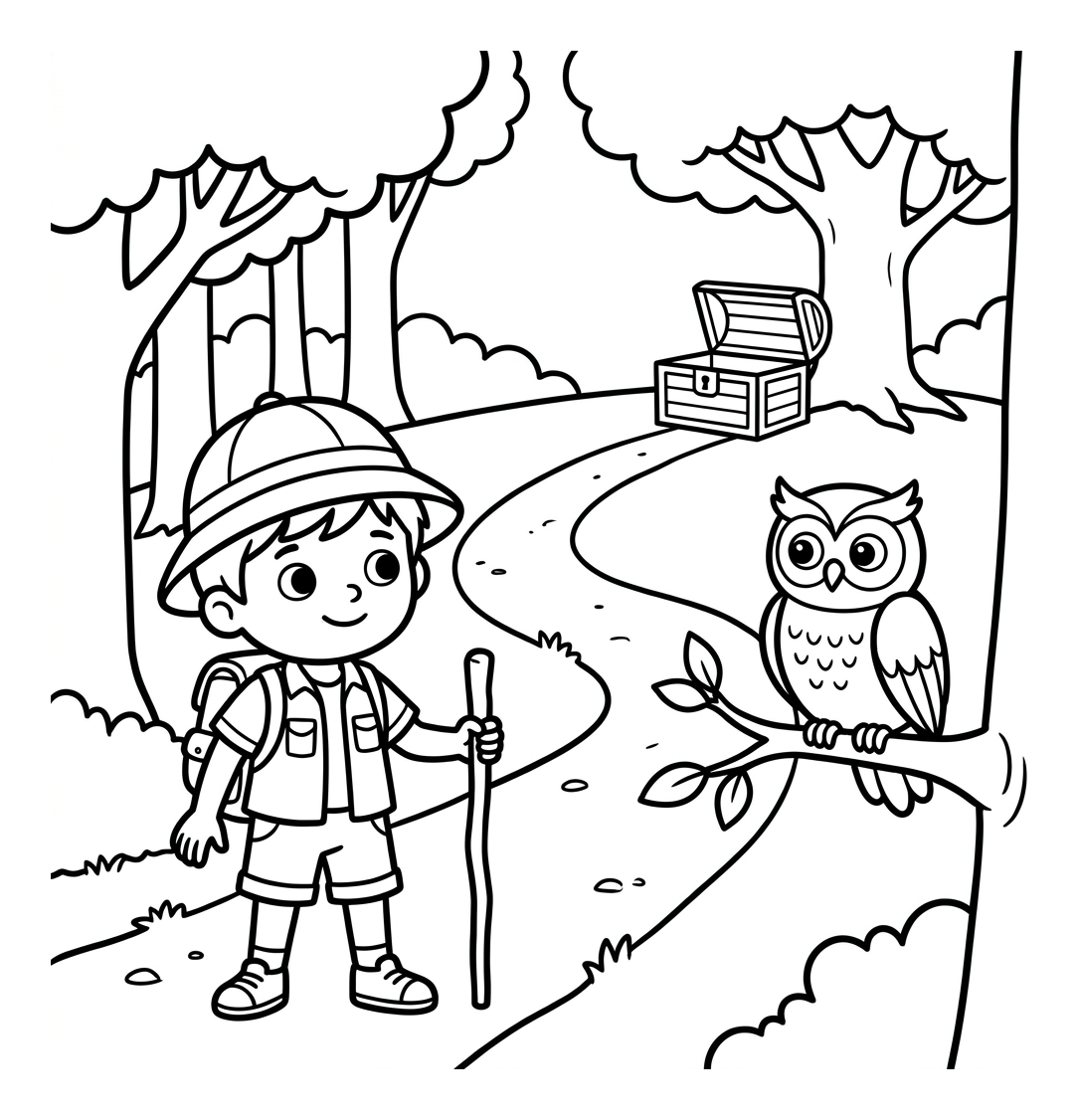
This free, print-friendly worksheet uses a single picture — an explorer setting off down a winding forest path towards a distant treasure chest — as a prompt. Children colour the scene, then plan their own short adventure by writing one sentence for each part of the story, with a word bank of sentence starters such as One day, Suddenly and In the end. It is designed to print neatly onto one A4 page for the classroom or the kitchen table.
What your child is learning
‘writing narratives about personal experiences and those of others (real and fictional)’
Year 2 English: Writing – composition, National Curriculum in England. Source and licence
Parts of a Story: Beginning, Middle and End
Free English worksheet · Ages 7 to 9
Colour the picture
Colour the explorer, the path, the squirrel and the treasure chest. Then follow the path from the explorer to the chest with your finger.
Plan your story
Plan your own adventure story. Write one sentence for each part. The word bank can help you start.
Beginning: Who is the explorer? Where are they?
Middle: What happens on the path? Is there a problem?
End: What happens at the treasure chest?
 Parts of a Story: Beginning, Middle and EndSheet 78
Answers: Parts of a Story: Beginning, Middle and End
Sheet 78
- Beginning: Who is the explorer? Where are they? — Example: One day a young explorer set off into the forest with a walking stick and a small backpack.
- Middle: What happens on the path? Is there a problem? — Example: Suddenly the path split in two and a friendly squirrel scampered down to point the way.
- End: What happens at the treasure chest? — Example: In the end the explorer opened the chest and found a shining golden key inside.
For grown-ups. Free worksheets and the Owee quiz app at owee.world
Answer key
- Beginning: Who is the explorer? Where are they? — Example: One day a young explorer set off into the forest with a walking stick and a small backpack.
- Middle: What happens on the path? Is there a problem? — Example: Suddenly the path split in two and a friendly squirrel scampered down to point the way.
- End: What happens at the treasure chest? — Example: In the end the explorer opened the chest and found a shining golden key inside.
What "beginning, middle and end" really means
In the KS2 classroom, story structure is often taught using three friendly labels: the opening (beginning), the build-up and problem (middle), and the resolution (end). The beginning introduces the characters and the setting and gives the reader a reason to care. The middle is where the action happens — something goes wrong, a goal must be reached, or a problem needs solving. The end ties everything together by resolving the problem and showing how the characters feel afterwards. Teaching children to recognise these three parts in stories they read makes it far easier for them to reproduce the same shape in the stories they write.
Why planning before writing matters
Years 3 and 4 mark the point where children move from writing whatever comes next to genuinely planning a piece of writing. The National Curriculum asks pupils to plan their writing by discussing and recording ideas, and a simple beginning-middle-end frame is the most accessible way to do this. When a child jots down a single sentence for each part before they begin, they are far less likely to run out of steam halfway through, repeat themselves, or finish abruptly with "and then I woke up". The plan acts as a map — much like the path on this worksheet — keeping the writing moving towards a satisfying finish.
How to get the most from this worksheet
Start by talking about the picture together. Ask who the explorer might be, where the path leads, and what could be hidden in the treasure chest — this oral rehearsal is valuable in its own right. Then encourage the child to write one clear sentence for the beginning (who and where), one for the middle (the problem or the journey), and one for the end (how it is resolved). There are no wrong answers: a worried explorer who turns back is just as valid as a brave one who opens the chest. For an extra challenge, ask older or more confident writers to expand each sentence into a full paragraph on a separate sheet, using their plan as the backbone.
Linking the picture to the writing
A picture helps reluctant writers because it removes the blank-page barrier: the character, the setting and the goal are already there, waiting to be described. The winding path is a useful visual metaphor for narrative itself: a story travels from a clear starting point, through twists and turns, to a destination. Pointing this out helps children understand that a good middle should build tension or interest rather than simply listing events. The friendly squirrel can become a helper character, a guide, or simply a witness, giving children an easy way to add a second character to their plan.
Frequently asked questions
What are the three parts of a story for KS2?
The three main parts are the beginning (the opening, which introduces the characters and setting), the middle (the build-up and the problem or main events) and the end (the resolution, where the problem is sorted out). Many schools use a five-part ‘story mountain’ in Years 3 and 4: opening, build-up, problem, resolution and ending. The middle of a three-part plan holds the build-up and the problem.
What age is this beginning, middle and end worksheet for?
It is aimed at children aged 7 to 9 (Years 3 and 4, Lower Key Stage 2). Confident Year 2 writers will also manage it with a little support, and it can be extended for older children by asking them to turn each planning sentence into a full paragraph.
How does this worksheet support the National Curriculum?
It supports the Years 3-4 writing composition objectives, especially planning writing by recording ideas and creating settings, characters and plot in narratives. The picture prompt also encourages composing and rehearsing sentences orally before writing.
How do I help my child plan a story?
Talk about the picture first so ideas form out loud, then ask for just one sentence about each part: who and where (beginning), what goes wrong or what the goal is (middle), and how it ends (end). Keeping it to a single sentence per part removes the pressure and gives a clear map to write from.
Is this worksheet free to print?
Yes. The worksheet is completely free and designed to print onto one A4 page at home or in the classroom. There is no sign-up required to download and use it.
Curriculum links
- Year 2 English: Writing – composition (statutory): 'writing narratives about personal experiences and those of others (real and fictional)'
- English, Years 3-4, Writing composition: 'discussing writing similar to that which they are planning to write in order to understand and learn from its structure, vocabulary and grammar'
- English, Years 3-4, Writing composition: 'in narratives, creating settings, characters and plot'
- English, Years 3-4, Reading comprehension: 'identifying themes and conventions in a wide range of books'
Quoted word for word from Department for Education documents: the National Curriculum in England, the EYFS framework or the RSHE guidance. Contains public sector information licensed under the Open Government Licence v3.0.
Made by The Owee education team. Updated 13/10/2026. Free to print and share.
More english worksheets
All Year 2 English worksheets →
Years 3–4 · GrammarSheet 109
Adverbs: How, When and Where
Years 3–4 · Dictionary skillsSheet 108
Alphabetical Order: Using a Dictionary
Years 3–4 · PunctuationSheet 149
Apostrophes for Possession
Years 1–2 · PunctuationSheet 24
Capital Letters and Full Stops
Years 2–3 · GrammarSheet 70
Conjunctions: because, but and so
Years 1–2 · GrammarSheet 71
Describing Words (Adjectives)
Educational quiz app · Ages 5-10
More learning in the Owee app
Owee turns topics like this into quizzes for children aged 5 to 10, and a treehouse grows as they learn. No ads, no chat, no strangers.
- Family-friendly
- No ads
- Private
Educational quiz app · Ages 5-10
More learning in the Owee app
Owee turns topics like this into quizzes for children aged 5 to 10, and a treehouse grows as they learn. No ads, no chat, no strangers.
Scan with your phone camera
- Family-friendly
- No ads
- Private