Educational quiz app · Ages 5-10
This is what learning looks like


Educational quiz app · Ages 5-10
This is what learning looks like
No nagging required. Keep the learning going after the worksheet, with every question read aloud and Owee guiding each step.
Scan with your phone camera
- Family-friendly
- No ads
- Private
Science · Colouring and sorting worksheet
States of Matter Worksheet: Solid, Liquid or Gas? (Free KS2 Printable)
This free printable worksheet supports the Year 4 Science topic on states of matter. Children look at familiar things in a kitchen-table scene and decide whether each one is a solid, a liquid or a gas, using simple tests they can apply to almost anything: does it keep its own shape, does it flow, and does it spread out to fill the space it is in?
It prints cleanly onto a single A4 page. The colouring activity makes a gentle warm-up, while the sorting questions check that children can reason from properties rather than simply memorise examples. It works equally well at home or as a quick classroom starter or plenary.
What your child is learning
‘compare and group materials together, according to whether they are solids, liquids or gases’
Year 4 Science: States of matter, National Curriculum in England. Source and licence
Solid, Liquid or Gas?
Free Science worksheet · Ages 8 to 9
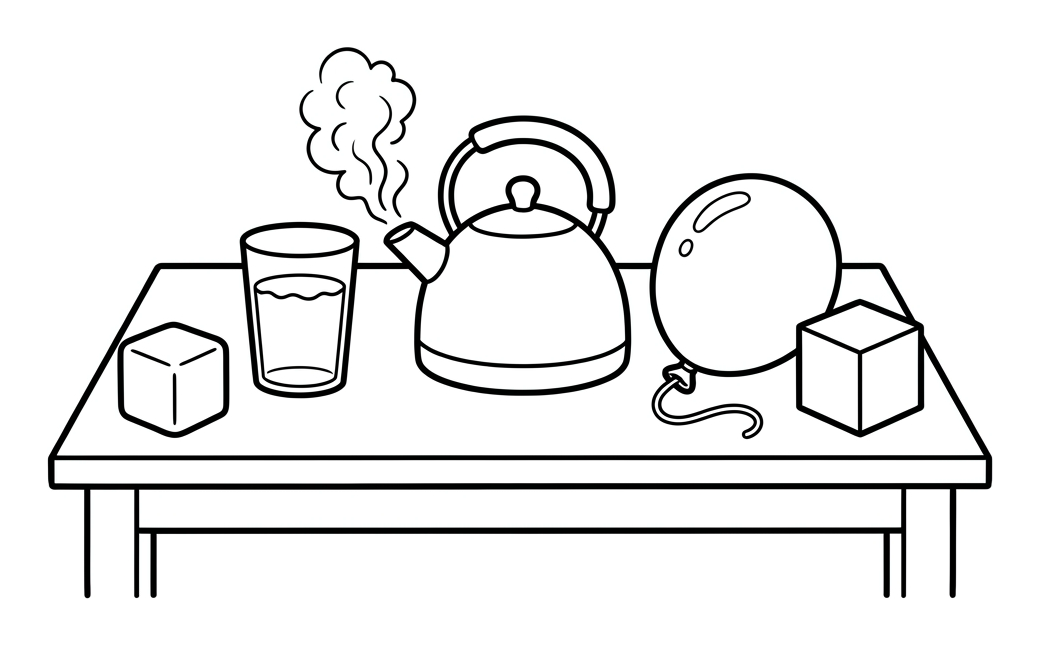
Colour the kitchen scene
Colour the picture of the kitchen table.
- Colour the ice cube (on the left) light blue and the wooden block (on the right) brown.
- Colour the water in the glass blue.
- Colour the steam light grey.
- Colour the kettle and the balloon any colours you like.
Solid, liquid or gas?
Write solid, liquid or gas for each one. Ask yourself: Does it keep its shape? Does it flow? Does it spread out to fill the space?
The ice cube on the table is a ...
The water in the glass is a ...
The steam coming out of the kettle is a ...
The air inside the balloon is a ...
The rubber skin of the balloon is a ...
Which thing in the picture could you pour to make a pool, not a pile?
 Solid, Liquid or Gas?Sheet 156
Answers: Solid, Liquid or Gas?
Sheet 156
- The ice cube on the table is a ... — solid
- The water in the glass is a ... — liquid
- The steam coming out of the kettle is a ... — gas (steam is water vapour; the white cloud you can see is where it cools into tiny drops of water)
- The air inside the balloon is a ... — gas
- The rubber skin of the balloon is a ... — solid
- Which thing in the picture could you pour to make a pool, not a pile? — The water (a liquid)
For grown-ups. Free worksheets and the Owee quiz app at owee.world
Answer key
- The ice cube on the table is a ... — solid
- The water in the glass is a ... — liquid
- The steam coming out of the kettle is a ... — gas (steam is water vapour; the white cloud you can see is where it cools into tiny drops of water)
- The air inside the balloon is a ... — gas
- The rubber skin of the balloon is a ... — solid
- Which thing in the picture could you pour to make a pool, not a pile? — The water (a liquid)
What Year 4 children need to know about states of matter
By the end of Year 4, children are expected to be able to group everyday materials into solids, liquids and gases. The key idea is that we sort by properties, not by what something is made of. A solid keeps its shape and does not flow; it takes up a fixed amount of space. A liquid flows and takes the shape of its container, but its surface stays level and it keeps the same volume. A gas has no fixed shape and spreads out to fill all the space available to it. Encouraging children to ask the three test questions on this sheet, namely 'Does it keep its shape?', 'Does it flow?' and 'Does it spread to fill the space?', gives them a reliable method they can apply to objects they have never met before.
Using everyday objects to teach the three states
The objects in the picture are deliberately ordinary so that the learning transfers to real life. The ice cube and the wooden block are clear solids that hold their shape. The water in the glass is a liquid that takes the shape of whatever it is poured into. The steam from the kettle and the air inside the balloon are gases, though gases are the trickiest state for children because we usually cannot see them. Talking about steam, breath on a cold day, bubbles in fizzy drinks and the air that fills a balloon helps children accept that gases are real materials even when invisible. A useful follow-up question is: 'If you open the lid, where does the steam go?' This draws out the idea that a gas spreads to fill the room.
Common misconceptions to watch for
Several misunderstandings appear again and again at this age, and gently correcting them now saves confusion later. Many children think that anything you can pour, such as sand, sugar or rice, must be a liquid; in fact these are tiny solid pieces, and each individual grain keeps its shape. Some assume that gases are not 'real' or weigh nothing, when in fact air and steam are genuine materials made of matter. Others confuse temperature with state, believing 'hot' automatically means gas. The ice cube is a helpful talking point here: it is the same substance as the water in the glass and the steam from the kettle, simply in a different state. Heating and cooling can change the state without changing what the material is.
How to get the most from this worksheet at home or in class
Begin with the colouring activity to settle children into the scene, then move to the sorting questions, asking them to explain their reasoning aloud rather than just giving a one-word answer. The balloon is the best talking point: its rubber skin is a solid, but the air inside it is a gas. The word bank offers gentle support for children who need it, while more confident learners can be challenged to add their own examples to each group. To extend the lesson, hunt for objects around the room and sort them, or set up a simple, supervised demonstration of an ice cube melting and water evaporating to show how one material can move between all three states. Linking the worksheet to a practical activity helps the vocabulary stick.
Frequently asked questions
What are the three states of matter for KS2?
The three states of matter taught at KS2 are solids, liquids and gases. A solid keeps its own shape, a liquid flows and takes the shape of its container, and a gas spreads out to fill all the space available to it. Children learn to sort materials by these properties in Year 4 Science.
Is this states of matter worksheet free to print?
Yes. The worksheet is completely free to download and print, with no sign-up required. It is designed to fit onto a single A4 page so it is quick and economical to print at home or in the classroom.
What age or year group is this worksheet for?
It is aimed at children aged 8 to 9, which matches Year 4 of the English National Curriculum in Lower KS2. The activities can also suit confident Year 3 children or be used for revision in early Year 5.
Is steam a gas or a liquid?
The invisible water vapour leaving the kettle is a gas. The white cloud we usually call steam is actually tiny droplets of liquid water that have cooled and condensed in the air. For this worksheet, the puffs coming from the kettle are treated as a gas, which is a helpful way to introduce the idea to children.
Why is sand not a liquid even though you can pour it?
Although sand can be poured, it is made of many tiny solid grains, and each grain keeps its own shape and does not change. A true liquid flows as one continuous material and takes the exact shape of its container. This is a common misconception worth discussing with children.
Curriculum links
- Year 4 Science: States of matter (statutory): 'compare and group materials together, according to whether they are solids, liquids or gases'
- Year 4 Science, States of Matter: 'observe that some materials change state when they are heated or cooled, and measure or research the temperature at which this happens in degrees Celsius'
- Year 4 Science, States of Matter: 'identify the part played by evaporation and condensation in the water cycle and associate the rate of evaporation with temperature'
Quoted word for word from Department for Education documents: the National Curriculum in England, the EYFS framework or the RSHE guidance. Contains public sector information licensed under the Open Government Licence v3.0.
Made by The Owee education team. Updated 13/10/2026. Free to print and share.
More science worksheets
All Year 4 Science worksheets →
Years 3–4 · Teeth and digestionSheet 157
Animal Teeth and What They Eat
Years 3–4 · Food chainsSheet 152
Build a Food Chain: Label and Colour
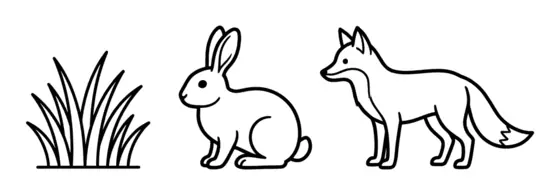
Years 3–4 · Food chainsSheet 153
Build a Food Chain: Label and True or False
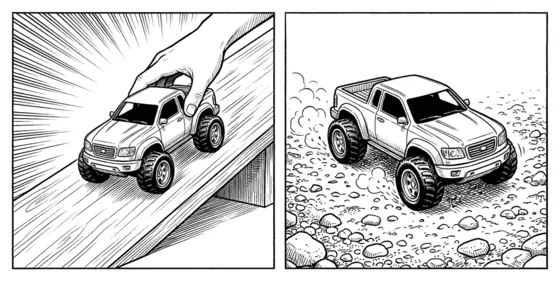
Years 3–5 · Forces and magnetsSheet 175
Forces and Friction
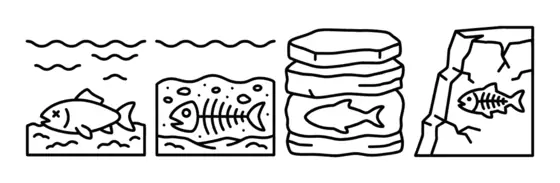
Years 3–4 · Rocks and fossilsSheet 120
How a Fossil Is Made
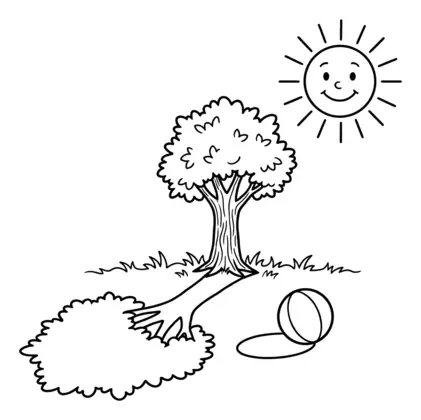
Years 3–4 · LightSheet 118
How Shadows Are Made
Educational quiz app · Ages 5-10
More learning in the Owee app
Owee turns topics like this into quizzes for children aged 5 to 10, and a treehouse grows as they learn. No ads, no chat, no strangers.
- Family-friendly
- No ads
- Private
Educational quiz app · Ages 5-10
More learning in the Owee app
Owee turns topics like this into quizzes for children aged 5 to 10, and a treehouse grows as they learn. No ads, no chat, no strangers.
Scan with your phone camera
- Family-friendly
- No ads
- Private