Educational quiz app · Ages 5-10
This is what learning looks like


Educational quiz app · Ages 5-10
This is what learning looks like
No nagging required. Keep the learning going after the worksheet, with every question read aloud and Owee guiding each step.
Scan with your phone camera
- Family-friendly
- No ads
- Private
English · Colouring and writing worksheet
Prepositions of Place: Where Is the Cat? Free KS2 Worksheet
Prepositions of place are the small but powerful words we use to say where something is, such as on, under, in, behind, beside, above and in front of. This free printable gives children aged 7 to 9 a friendly, low-pressure way to spot these words and use them accurately in full sentences.
The worksheet pairs a colouring scene with short writing tasks. After colouring a cosy living room, children look closely at where the cat is sitting in relation to the furniture and then write sentences using the word bank provided. It prints neatly onto a single sheet of A4 and needs nothing more than a pencil and some colouring pencils.
What your child is learning
‘Expressing time, place and cause using conjunctions [for example, when, before, after, while, so, because], adverbs [for example, then, next, soon, therefore], or prepositions [for example, before, after, during, in, because of]’
Year 3 English: Vocabulary, grammar and punctuation (Appendix 2), National Curriculum in England. Source and licence
Prepositions: Where Is the Cat?
Free English worksheet · Ages 7 to 9
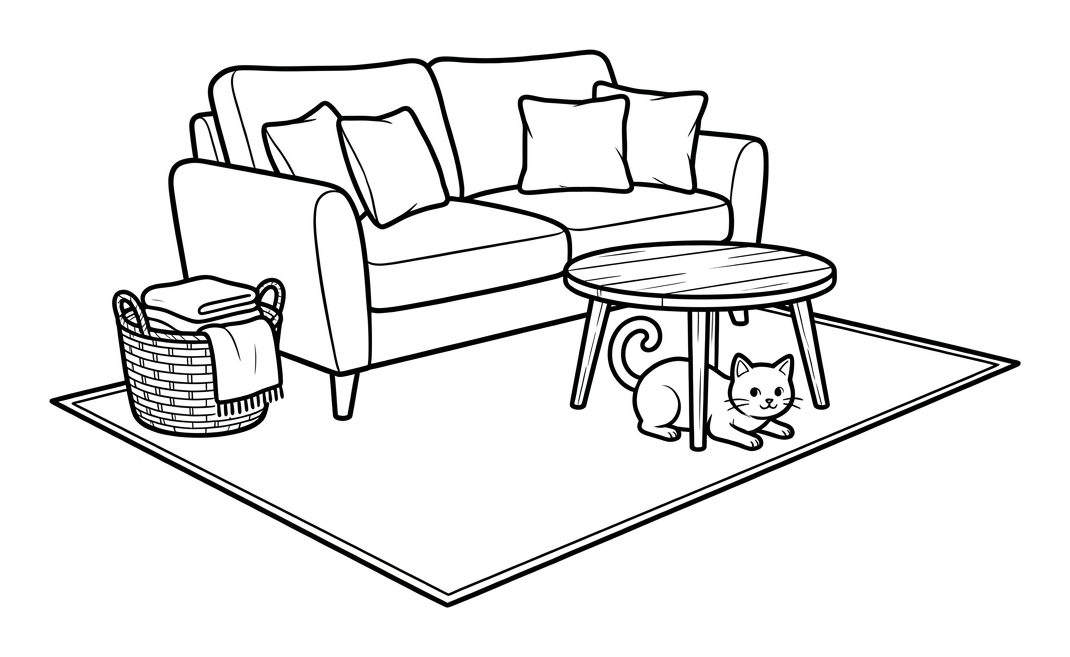
Colour the room
Colour the cat, the sofa, the table, the rug and the basket. Look carefully at where everything is.
Where is it?
Fill each gap with the best preposition from the word bank. Then write your own sentences. Start with a capital letter and end with a full stop.
The cat is __ the table.
The table is __ the cat.
The cushions are __ the sofa.
Write a sentence about where the basket is.
Write a sentence about where the rug is.
 Prepositions: Where Is the Cat?Sheet 110
Answers: Prepositions: Where Is the Cat?
Sheet 110
- The cat is under the table.
- The table is above the cat.
- The cushions are on the sofa.
- Write a sentence about where the basket is. — Answers will vary, for example: The basket is beside the sofa. (on the rug also works)
- Write a sentence about where the rug is. — Answers will vary, for example: The rug is in front of the sofa. (under the table also works)
For grown-ups. Free worksheets and the Owee quiz app at owee.world
Answer key
- The cat is under the table.
- The table is above the cat.
- The cushions are on the sofa.
- Write a sentence about where the basket is. — Answers will vary, for example: The basket is beside the sofa. (on the rug also works)
- Write a sentence about where the rug is. — Answers will vary, for example: The rug is in front of the sofa. (under the table also works)
What your child practises on this worksheet
This sheet focuses on prepositions of place — words that show the position of one thing relative to another. By describing exactly where the cat is in the picture, children learn to choose the most precise preposition rather than relying on a vague answer like ‘there’. The task moves them from recognising prepositions to using them confidently in writing, which is the step the national curriculum expects in Year 3. A preposition is always followed by a noun or noun phrase (under the table, on the sofa). Without one, the same word is working as an adverb: in ‘The cat ran under’, under is an adverb. Writing complete sentences (rather than single words) also reinforces capital letters, full stops and clear subject-verb structure, so a grammar activity quietly doubles as sentence-writing practice.
How to use it at home or in the classroom
Begin with the colouring: it settles children and gives them time to study the scene before they write. Once the room is coloured, talk through the picture together — ‘Where is the cat? What is it next to? What is above it?’ — before any writing begins. Encourage children to point to the objects as they describe them, as physical gesture helps fix the meaning of each preposition. For the writing task, remind them to start each sentence with a capital letter and end with a full stop, and to choose a preposition from the word bank that matches the picture exactly. Pairs or small groups can compare their sentences afterwards; there is often more than one correct way to describe a position, which makes for good discussion.
Why prepositions of place matter
Accurate prepositions make writing clear. Without them, a description can leave the reader guessing — ‘the cat is the table’ tells us nothing useful. Mastering position words supports children far beyond English lessons: they describe diagrams in science, give directions in geography and explain their methods in maths. Prepositions are also among the words most easily confused by children learning English as an additional language, so deliberate, picture-based practice is valuable. Because the meaning is anchored to a clear image, this worksheet suits a wide range of confidence levels within the 7-to-9 age band.
Extending the activity
The first two gaps on the sheet show that position is relative: the cat is under the table, so the table is above the cat. Once the sheet is complete, stretch confident writers by asking them to do the same with another pair, such as ‘The cushions are on the sofa’ and ‘The sofa is under the cushions’. You might also play a quick spoken game: one person describes where an object is in the real room and the other has to find it using only the preposition clue. To link the work to wider grammar, point out that prepositions also express time and cause (‘before tea’, ‘because of the rain’), so children begin to see that one small group of words does several jobs in English.
Frequently asked questions
What is a preposition of place?
A preposition of place is a word that tells you where something is in relation to something else, such as on, under, in, behind, beside, above or in front of. This worksheet helps children practise choosing the right one to describe where the cat is sitting.
What age and key stage is this worksheet for?
It is designed for children aged 7 to 9, which covers Years 3 and 4 of Key Stage 2 in England. The colouring element keeps it accessible for those at the younger end of the range, while the full-sentence writing task suits children who are ready for more.
Is this prepositions worksheet free to print?
Yes. The worksheet is completely free, fits on a single A4 page and can be printed at home or in the classroom. You only need a printer, a pencil and some colouring pencils.
Which prepositions does the worksheet cover?
It focuses on the common prepositions of place: on, under, in, behind, beside, above and in front of. These are provided in a word bank so children can choose the most accurate word for each sentence.
How does this link to the National Curriculum?
It supports the Year 3 grammar objective in English Appendix 2, which asks children to express place using prepositions, and it reinforces the accurate use of the term ‘preposition’ when discussing writing in Years 3 and 4.
Curriculum links
- Year 3 English: Vocabulary, grammar and punctuation (Appendix 2) (statutory): 'Expressing time, place and cause using conjunctions [for example, when, before, after, while, so, because], adverbs [for example, then, next, soon, therefore], or prepositions [for example, before, after, during, in, because of]'
Quoted word for word from Department for Education documents: the National Curriculum in England, the EYFS framework or the RSHE guidance. Contains public sector information licensed under the Open Government Licence v3.0.
Made by The Owee education team. Updated 13/10/2026. Free to print and share.
More english worksheets
All Year 3 English worksheets →
Years 3–4 · GrammarSheet 109
Adverbs: How, When and Where
Years 2–3 · GrammarSheet 70
Conjunctions: because, but and so
Years 1–2 · GrammarSheet 71
Describing Words (Adjectives)
Years 1–2 · GrammarSheet 72
Doing Words (Verbs)
Years 1–2 · GrammarSheet 73
Naming Words (Nouns)
Years 2–3 · GrammarSheet 74
Spot the Nouns, Verbs and Adjectives
Educational quiz app · Ages 5-10
More learning in the Owee app
Owee turns topics like this into quizzes for children aged 5 to 10, and a treehouse grows as they learn. No ads, no chat, no strangers.
- Family-friendly
- No ads
- Private
Educational quiz app · Ages 5-10
More learning in the Owee app
Owee turns topics like this into quizzes for children aged 5 to 10, and a treehouse grows as they learn. No ads, no chat, no strangers.
Scan with your phone camera
- Family-friendly
- No ads
- Private