Educational quiz app · Ages 5-10
This is what learning looks like


Educational quiz app · Ages 5-10
This is what learning looks like
No nagging required. Keep the learning going after the worksheet, with every question read aloud and Owee guiding each step.
Scan with your phone camera
- Family-friendly
- No ads
- Private
Science · Writing and colouring worksheet
Order of the Planets Worksheet (Free KS2 Science)
This free printable worksheet helps children in Years 5 and 6 name the eight planets of the solar system in order of their distance from the Sun, from Mercury out to Neptune. It pairs a writing task with a colour-in line drawing of the Sun and planets. The word bank lists the planets in a jumbled order, so children have to recall the sequence rather than copy it.
What your child is learning
‘describe the movement of the Earth and other planets relative to the sun in the solar system’
Year 5 Science: Earth and space, National Curriculum in England. Source and licence
Order of the Planets
Free Science worksheet · Ages 9 to 11
Name the planets in order
Write the eight planets in order, starting with the one closest to the Sun. The word bank has them all mixed up.
1st planet from the Sun (closest)
2nd planet from the Sun
3rd planet from the Sun (the one we live on)
4th planet from the Sun (the red planet)
5th planet from the Sun (the largest planet)
6th planet from the Sun (the one with bright rings)
7th planet from the Sun
8th planet from the Sun (furthest away)
Colour the solar system
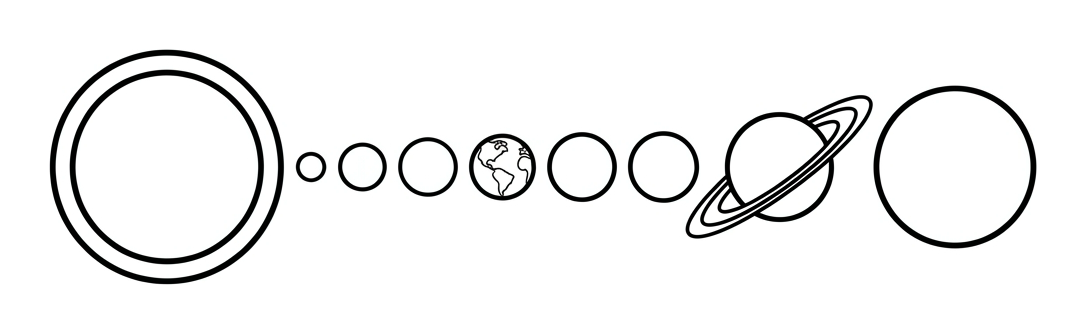
Colour the Sun and the planets. They are drawn in order from the Sun, but not to scale. Use your list to check which is which.
- Colour the Sun bright yellow and orange.
- Find the Earth, the third planet from the Sun. Colour it blue and green.
- Colour Saturn's rings a different colour from the planet.
 Order of the PlanetsSheet 171
Answers: Order of the Planets
Sheet 171
- 1st planet from the Sun (closest) — Mercury
- 2nd planet from the Sun — Venus
- 3rd planet from the Sun (the one we live on) — Earth
- 4th planet from the Sun (the red planet) — Mars
- 5th planet from the Sun (the largest planet) — Jupiter
- 6th planet from the Sun (the one with bright rings) — Saturn
- 7th planet from the Sun — Uranus
- 8th planet from the Sun (furthest away) — Neptune
For grown-ups. Free worksheets and the Owee quiz app at owee.world
Answer key
- 1st planet from the Sun (closest) — Mercury
- 2nd planet from the Sun — Venus
- 3rd planet from the Sun (the one we live on) — Earth
- 4th planet from the Sun (the red planet) — Mars
- 5th planet from the Sun (the largest planet) — Jupiter
- 6th planet from the Sun (the one with bright rings) — Saturn
- 7th planet from the Sun — Uranus
- 8th planet from the Sun (furthest away) — Neptune
What this worksheet covers
The worksheet supports the Year 5 'Earth and space' topic in the National Curriculum. Children name the eight planets in order of distance from the Sun — Mercury, Venus, Earth, Mars, Jupiter, Saturn, Uranus and Neptune — and identify the Sun as the star at the centre of the solar system. Clues on the lines (the planet we live on, the red planet, the largest planet, the one with bright rings) help children who are unsure, and talking through them is a good way to add that the four inner planets are small and rocky while the four outer planets are much larger gas and ice giants. It is designed to print cleanly on one A4 page, making it easy to use at home or in the classroom.
A simple way to remember the order
Many children find a mnemonic helps the eight planets stick. A traditional British example is My Very Easy Method Just Speeds Up Naming, where each initial letter matches a planet from the Sun outwards: Mercury, Venus, Earth, Mars, Jupiter, Saturn, Uranus, Neptune. Encourage children to say the order aloud and then write it from memory, checking each first letter against the mnemonic. Note that Pluto is no longer counted as a planet: since 2006 it has been classified by the International Astronomical Union as a dwarf planet, so the curriculum focuses on the eight planets only.
Background for parents and teachers
The Sun is a star, and its gravity holds the solar system together while the planets orbit around it. The four planets closest to the Sun — Mercury, Venus, Earth and Mars — are small and made mostly of rock and metal. Beyond Mars lie the giants: Jupiter and Saturn are gas giants, while Uranus and Neptune are ice giants, all far larger than Earth. Saturn is famous for its bright system of rings, which is why it is drawn with a ring on the worksheet. Distances in space are vast: Neptune orbits roughly thirty times further from the Sun than Earth does, so no drawing on a single page can show true spacing or scale. The drawing on this sheet is for colouring only and does not show the planets in order, so children should check their list against the mnemonic rather than the picture.
Ways to extend the learning
Once children can name the planets in order, try a few follow-up questions to deepen understanding: which planet do we live on (Earth, the third from the Sun)? Which is the largest planet (Jupiter)? Which planet is known for its rings (Saturn)? You could also ask children to sort the eight planets into the four rocky inner planets and the four outer giants, or to research one fact about each planet. For an active version, send children outside to walk out the order of the planets as a human solar system, calling each name in turn.
Frequently asked questions
What are the eight planets in order from the Sun?
In order of distance from the Sun, the eight planets are Mercury, Venus, Earth, Mars, Jupiter, Saturn, Uranus and Neptune. Mercury is closest to the Sun and Neptune is furthest away.
Is this worksheet suitable for KS2?
Yes. It is aimed at children aged 9 to 11 in Years 5 and 6 (KS2) and supports the Year 5 'Earth and space' topic in the National Curriculum, where pupils describe the movement of the planets relative to the Sun.
Why is Pluto not on the worksheet?
Pluto was reclassified as a dwarf planet by the International Astronomical Union in 2006, so it is no longer counted among the main planets. The curriculum focuses on the eight planets, which is why Pluto does not appear here.
Is there a rhyme to remember the order of the planets?
A popular British mnemonic is 'My Very Easy Method Just Speeds Up Naming'. The first letter of each word matches a planet in order from the Sun: Mercury, Venus, Earth, Mars, Jupiter, Saturn, Uranus, Neptune.
Is the worksheet free to print?
Yes. The worksheet is completely free to download and print. It is designed to fit on a single A4 page so you can use it at home or in the classroom straight away.
Curriculum links
- Year 5 Science: Earth and space (statutory): 'describe the movement of the Earth and other planets relative to the sun in the solar system'
- Year 5 Science, Earth and space: 'describe the Sun, Earth and Moon as approximately spherical bodies'
Quoted word for word from Department for Education documents: the National Curriculum in England, the EYFS framework or the RSHE guidance. Contains public sector information licensed under the Open Government Licence v3.0.
Made by The Owee education team. Updated 13/10/2026. Free to print and share.
More science worksheets
All Year 5 Science worksheets →
Years 5–6 · Earth and spaceSheet 170
Day and Night on Earth
Years 1–2 · Earth and spaceSheet 32
Label a Space Rocket
Years 1–2 · Earth and spaceSheet 33
Meet an Astronaut
Years 5–6 · Earth and spaceSheet 172
Phases of the Moon
Years 5–6 · Earth and spaceSheet 173
Star Patterns in the Night Sky
Years 5–6 · Earth and spaceSheet 174
The Earth, Sun and Moon
Educational quiz app · Ages 5-10
More learning in the Owee app
Owee turns topics like this into quizzes for children aged 5 to 10, and a treehouse grows as they learn. No ads, no chat, no strangers.
- Family-friendly
- No ads
- Private
Educational quiz app · Ages 5-10
More learning in the Owee app
Owee turns topics like this into quizzes for children aged 5 to 10, and a treehouse grows as they learn. No ads, no chat, no strangers.
Scan with your phone camera
- Family-friendly
- No ads
- Private