Educational quiz app · Ages 5-10
This is what learning looks like


Educational quiz app · Ages 5-10
This is what learning looks like
No nagging required. Keep the learning going after the worksheet, with every question read aloud and Owee guiding each step.
Scan with your phone camera
- Family-friendly
- No ads
- Private
Music · Colouring and sorting worksheet
Families of the Orchestra: Free KS2 Music Worksheet
A symphony orchestra can hold sixty or more players, yet almost every instrument belongs to one of four families — strings, woodwind, brass and percussion. Grouping instruments this way helps children listen more carefully and begin to notice how each family makes its own kind of sound, or timbre.
This free printable for Years 3 and 4 asks children to sort named instruments into the correct family using a word bank, then colour the four instruments in the picture. It works well as a quiet listening activity alongside a recording, or as a quick recap after a class music lesson.
What your child is learning
‘appreciate and understand a wide range of high-quality live and recorded music drawn from different traditions and from great composers and musicians’
Key stage 2 Music, National Curriculum in England. Source and licence

Families of the Orchestra
Free Music worksheet · Ages 7 to 9
Activity 1
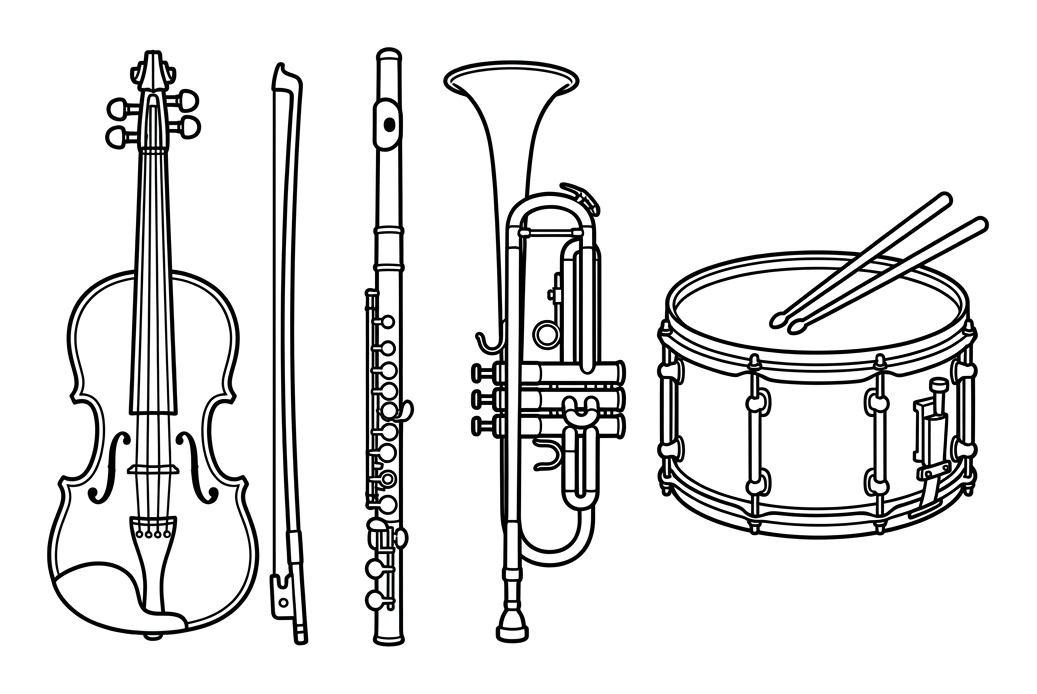
Colour the four instruments in the picture. Look closely at the shape of each one as you colour.
- Colour the violin a warm wooden brown.
- Colour the flute and the trumpet shiny silver or gold.
- Colour the snare drum any bright colour you like.
Activity 2
Sort these instruments into the four families of the orchestra. Write each instrument under the correct heading. Use the word bank to help you.
Strings family — write two instruments:
Woodwind family — write two instruments:
Brass family — write two instruments:
Percussion family — write two instruments:
 Families of the OrchestraSheet 132
Answers: Families of the Orchestra
Sheet 132
- Strings family — write two instruments: — violin, cello
- Woodwind family — write two instruments: — flute, clarinet
- Brass family — write two instruments: — trumpet, trombone
- Percussion family — write two instruments: — snare drum, timpani
For grown-ups. Free worksheets and the Owee quiz app at owee.world
Answer key
- Strings family — write two instruments: — violin, cello
- Woodwind family — write two instruments: — flute, clarinet
- Brass family — write two instruments: — trumpet, trombone
- Percussion family — write two instruments: — snare drum, timpani
The four families of the orchestra
Orchestral instruments are grouped by how they make their sound, not just by what they look like. Strings (the violin, viola, cello and double bass, plus the harp) make sound when their strings vibrate, either bowed or plucked with the fingers. Woodwind instruments (flute, clarinet, oboe and bassoon) make sound from a vibrating column of air, often set off by a reed; the flute is still counted as woodwind even though modern ones are made of metal. Brass instruments (trumpet, trombone, French horn and tuba) are played by buzzing the lips into a mouthpiece. Percussion instruments (snare drum, timpani, triangle, cymbals and xylophone) are struck, shaken or scraped.
Why we group instruments by family
Sorting instruments into families gives children a simple framework for an otherwise large and unfamiliar group of objects. Once a child knows the four families, they can predict roughly how an instrument is played and what it might sound like, which supports careful, attentive listening. The families also explain how a composer builds texture: a passage might begin with gentle strings, add a bright brass fanfare, then bring in percussion for a strong rhythm. Recognising the families by ear is a real musical skill, and it grows with repeated listening.
How to use this worksheet at home or in class
Begin by talking through the four family headings and the instruments in the word bank, drawing on any instruments the child has seen or heard. Children then write each instrument under the correct family. To deepen the activity, play a short recording and pause to ask which family is playing. Two pieces were written for exactly this: Britten’s The Young Person’s Guide to the Orchestra, which shows off each family in turn, and Prokofiev’s Peter and the Wolf, where the bird is a flute, the cat a clarinet and the wolf three French horns. The colouring suits children who finish quickly, and gives a calm way to talk about the shape of each instrument: the violin’s curved body, the flute’s keys, the trumpet’s three valves. There is no need for any musical training to lead this; the answers are provided below.
Common mix-ups to watch for
A few instruments regularly catch children out. The flute is woodwind, not brass, even though it is shiny metal — it belongs with woodwind because of how the sound is produced. The piano is sometimes met as a percussion or string instrument and is often treated separately, so it is best left out of this first sort. The saxophone is brass-coloured but is classed as woodwind because it uses a reed. Pointing out the how it is played rule — bowed, blown through a reed, lip-buzzed, or struck — helps children reason their way to the right family rather than guessing from appearance.
Frequently asked questions
What are the four families of the orchestra?
The four families are strings, woodwind, brass and percussion. Instruments are grouped by how they make their sound: strings are bowed or plucked, woodwind players blow across a hole or through a reed, brass players buzz their lips into a mouthpiece, and percussion is struck, shaken or scraped.
Is the flute a woodwind or brass instrument?
The flute is a woodwind instrument, even though modern flutes are made of metal. It is grouped with woodwind because of how the sound is made — by blowing across a hole to set air vibrating — rather than by what it is made of.
What age or year group is this worksheet for?
It is designed for KS2 children aged 7 to 9, typically Years 3 and 4, but it can be used with confident Year 2 pupils or as a recap for older children meeting the orchestra for the first time.
Which curriculum does this worksheet support?
It supports the KS2 Music programme of study in England, especially listening to a wide range of music with attention to detail, and understanding timbre and texture — the way different instrument families sound and combine.
Is this orchestra worksheet free to print?
Yes. The worksheet is completely free to download and print at home or in school. It is designed to fit on a single A4 page and needs no special equipment, just something to write and colour with.
Curriculum links
- Key stage 2 Music (statutory): 'appreciate and understand a wide range of high-quality live and recorded music drawn from different traditions and from great composers and musicians'
- Music KS2: 'listen with attention to detail and recall sounds with increasing aural memory'
- Music KS2: 'develop an understanding of the history of music'
Quoted word for word from Department for Education documents: the National Curriculum in England, the EYFS framework or the RSHE guidance. Contains public sector information licensed under the Open Government Licence v3.0.
Made by The Owee education team. Updated 13/10/2026. Free to print and share.
Educational quiz app · Ages 5-10
More learning in the Owee app
Owee turns topics like this into quizzes for children aged 5 to 10, and a treehouse grows as they learn. No ads, no chat, no strangers.
- Family-friendly
- No ads
- Private
Educational quiz app · Ages 5-10
More learning in the Owee app
Owee turns topics like this into quizzes for children aged 5 to 10, and a treehouse grows as they learn. No ads, no chat, no strangers.
Scan with your phone camera
- Family-friendly
- No ads
- Private