Educational quiz app · Ages 5-10
This is what learning looks like


Educational quiz app · Ages 5-10
This is what learning looks like
No nagging required. Keep the learning going after the worksheet, with every question read aloud and Owee guiding each step.
Scan with your phone camera
- Family-friendly
- No ads
- Private
Geography · Colouring and counting worksheet
Lunar New Year Zodiac Animals Worksheet: Free KS1 Colouring and Counting Printable
Lunar New Year is one of the most widely celebrated festivals in the world, marked by families in China and many other countries in East and South East Asia, and by communities here in the UK. This free printable introduces young children to the festival through the first five of its twelve zodiac animals, with a colouring task and three counting questions on a single A4 page.
It is designed for children aged 5 to 7 and works as a calm activity for the classroom, an after-school club or the kitchen table at home. You need only a printer and some colouring pencils.
What your child is learning
‘Know some similarities and differences between different religious and cultural communities in this country, drawing on their experiences and what has been read in class.’
Reception (EYFS): People, Culture and Communities early learning goal (closest statutory match), Department for Education. Source and licence
Lunar New Year Zodiac Animals
Free Geography worksheet · Ages 5 to 7
Activity 1
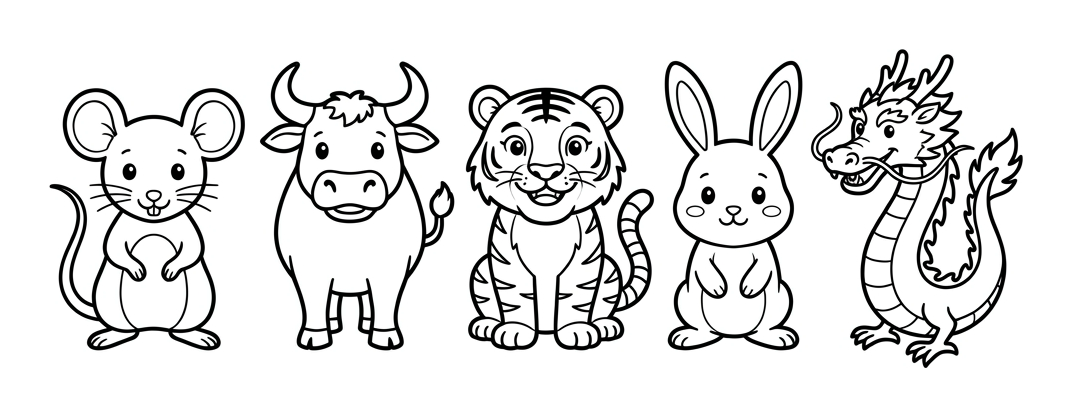
Colour the five zodiac animals. Try to choose a different colour for each animal.
- Colour the rat grey.
- Colour the tiger orange with black stripes.
- Colour the dragon red, the lucky colour of Lunar New Year.
Activity 2
Count carefully and write your answer in each box.
- How many zodiac animals can you see?
- The rat is number 1 in the zodiac. What number is the tiger?
- There are 12 zodiac animals in all. How many are not in the picture?
 Lunar New Year Zodiac AnimalsSheet 8
Answers: Lunar New Year Zodiac Animals
Sheet 8
- How many zodiac animals can you see? — 5
- The rat is number 1 in the zodiac. What number is the tiger? — 3
- There are 12 zodiac animals in all. How many are not in the picture? — 7
For grown-ups. Free worksheets and the Owee quiz app at owee.world
Answer key
- How many zodiac animals can you see? — 5
- The rat is number 1 in the zodiac. What number is the tiger? — 3
- There are 12 zodiac animals in all. How many are not in the picture? — 7
What is Lunar New Year?
Lunar New Year marks the start of a new year in a calendar based on the moon, so the festival falls on a different day each year, somewhere between 21 January and 20 February. It is celebrated in China, where it is often called Spring Festival or Chinese New Year, and in many other places including Vietnam, South Korea, Singapore and Malaysia, each with their own traditions. Families clean their homes, hang red decorations, share a big meal and give children red envelopes with money inside. Red is thought to bring good luck. For young children the key idea is simple: families come together to welcome a new year with food, decorations and visits.
The twelve zodiac animals
A favourite part of the festival for children is the zodiac, a cycle of twelve animals that each take a turn to represent a year. The full set, in order, is the rat, ox, tiger, rabbit, dragon, snake, horse, goat, monkey, rooster, dog and pig. A well-loved legend tells of a great race between the animals, which they finished in this order; the clever rat rode on the ox's back and jumped ahead at the end. The picture shows the first five animals, a manageable group to name, colour and count. 2026 is the Year of the Horse, which began on 17 February 2026, and the Year of the Goat (sometimes called the Sheep) begins on 6 February 2027. In Vietnam the zodiac has a cat instead of a rabbit, which is a nice example of one festival being marked in different ways.
How to use this worksheet
Begin by talking about the picture together and naming each animal before any colouring starts. Ask whether your child has seen any of these animals in a story or at a Lunar New Year event. The colouring gives children time to look closely at each animal. The counting questions build early number skills: the second asks for the tiger's place in the line (third), and the third asks how many of the twelve animals are missing (seven), which younger children can work out by counting on from 5 on their fingers. You might also find out which zodiac animal matches the year your child was born. Children born in January or early February belong to the previous year's animal, because the zodiac year starts at Lunar New Year, not on 1 January.
Linking to the wider curriculum
This printable supports early learning about festivals and celebrations from around the world, a theme in Early Years work on people, culture and communities and in many locally agreed Religious Education syllabuses. It also links to early maths through counting and ordinal numbers (first, second, third), to speaking and listening as children describe the animals, and to art through their colour choices. If your child's class includes families who celebrate Lunar New Year, they may be happy to share how they mark it, which helps children see the festival as part of life in the UK today.
Frequently asked questions
What are the 12 Chinese zodiac animals in order?
The twelve zodiac animals in order are the rat, ox, tiger, rabbit, dragon, snake, horse, goat, monkey, rooster, dog and pig. A traditional legend explains this order through a great animal race, with the clever rat finishing first. This worksheet shows the first five: the rat, ox, tiger, rabbit and dragon.
Is this Lunar New Year worksheet suitable for Reception and Year 1?
Yes. The worksheet suits Reception, Year 1 and Year 2. The colouring is accessible for the youngest children, and the counting questions stretch early number skills; Reception children may need help with the last question, which goes beyond 10.
When is Lunar New Year celebrated?
Lunar New Year follows a calendar based on the moon, so the date changes each year. It always falls between 21 January and 20 February: it was on 17 February in 2026 and will be on 6 February in 2027. Because it does not have a fixed date, it is a good chance to talk with children about how different calendars work.
What is the difference between Chinese New Year and Lunar New Year?
Chinese New Year is the name often used for the festival as celebrated in China, where it is also called Spring Festival. Lunar New Year is a broader term covering the same celebration in many countries across East and South East Asia, each with their own customs, such as Tết in Vietnam and Seollal in Korea.
Do I need any special equipment to use this printable?
No. You only need a printer, some paper and colouring pencils or crayons. The worksheet fits on one A4 page, so it is ready to use straight away at home or in the classroom.
Curriculum links
- Reception (EYFS): People, Culture and Communities early learning goal (closest statutory match) (statutory): 'Know some similarities and differences between different religious and cultural communities in this country, drawing on their experiences and what has been read in class.'
Quoted word for word from Department for Education documents: the National Curriculum in England, the EYFS framework or the RSHE guidance. Contains public sector information licensed under the Open Government Licence v3.0.
Made by The Owee education team. Updated 13/10/2026. Free to print and share.
More geography worksheets
All Reception Geography worksheets →
Reception–Year 1 · Festivals and celebrationsSheet 7
Festivals Around the World
Reception–Year 1 · Seaside and coastsSheet 43
At the Seaside: Land and Sea

Reception–Year 1 · The UKSheet 44
Colour the Union Flag
Years 1–2 · Map skillsSheet 89
Compass Directions: North, East, South, West
Years 1–2 · The UKSheet 92
Countries and Capitals of the UK
Years 1–2 · Hot and cold placesSheet 88
Hot and Cold Places of the World
Educational quiz app · Ages 5-10
More learning in the Owee app
Owee turns topics like this into quizzes for children aged 5 to 10, and a treehouse grows as they learn. No ads, no chat, no strangers.
- Family-friendly
- No ads
- Private
Educational quiz app · Ages 5-10
More learning in the Owee app
Owee turns topics like this into quizzes for children aged 5 to 10, and a treehouse grows as they learn. No ads, no chat, no strangers.
Scan with your phone camera
- Family-friendly
- No ads
- Private