Educational quiz app · Ages 5-10
This is what learning looks like


Educational quiz app · Ages 5-10
This is what learning looks like
No nagging required. Keep the learning going after the worksheet, with every question read aloud and Owee guiding each step.
Scan with your phone camera
- Family-friendly
- No ads
- Private
Art · Drawing and colouring worksheet
How to Draw a Face: Free KS2 Art Worksheet (Ages 7 to 9)
Drawing a face feels difficult to many children, yet most of the difficulty comes from placing the features in the wrong spot rather than from poor drawing. This free worksheet teaches a rule artists have used for centuries: the eyes sit roughly halfway down the head, not near the top.
Designed for KS2 children aged 7 to 9, the sheet pairs five short questions on where the eyes, nose, mouth and ears belong with a friendly portrait to colour. It prints on a single A4 page, for a home art afternoon or a classroom lesson on drawing techniques.
What your child is learning
‘to improve their mastery of art and design techniques, including drawing, painting and sculpture with a range of materials [for example, pencil, charcoal, paint, clay]’
Key stage 2 Art and design, National Curriculum in England. Source and licence
How to Draw a Face
Free Art worksheet · Ages 7 to 9
Where does each feature belong?
Artists use simple rules to place the parts of a face. Answer each question. Use the word bank to help you.
How far down the head do the eyes go?
Where does the bottom of the nose go?
Where does the mouth go?
Where do the ears go on the sides of the head?
How wide is the gap between the two eyes?
Colour the portrait
Now colour the face. Choose colours for the skin, eyes and hair to match yourself, someone you know, or a character you invent.
 How to Draw a FaceSheet 131
Answers: How to Draw a Face
Sheet 131
- How far down the head do the eyes go? — halfway down the head
- Where does the bottom of the nose go? — halfway between the eyes and the chin
- Where does the mouth go? — between the nose and the chin (nearer the nose)
- Where do the ears go on the sides of the head? — from the eyes down to the bottom of the nose
- How wide is the gap between the two eyes? — about one eye wide
For grown-ups. Free worksheets and the Owee quiz app at owee.world
Answer key
- How far down the head do the eyes go? — halfway down the head
- Where does the bottom of the nose go? — halfway between the eyes and the chin
- Where does the mouth go? — between the nose and the chin (nearer the nose)
- Where do the ears go on the sides of the head? — from the eyes down to the bottom of the nose
- How wide is the gap between the two eyes? — about one eye wide
Why face proportions matter
When children draw a face from imagination, they often crowd the eyes, nose and mouth into the top part of the head. The result looks baby-like or unbalanced, which can be discouraging. Teaching a simple proportion rule early gives children a reliable framework they can return to every time they draw a portrait. The key idea is that the eyes fall at the halfway line of the head, leaving generous room above for the forehead and hair. From there, the other features follow: the bottom of the nose sits about halfway between the eyes and the chin, the mouth about a third of the way from the nose to the chin, and the ears between the eye line and the bottom of the nose. The gap between the eyes is about one eye wide. Knowing these rules helps children see drawing as something that can be learned, not a fixed talent.
How to use this worksheet
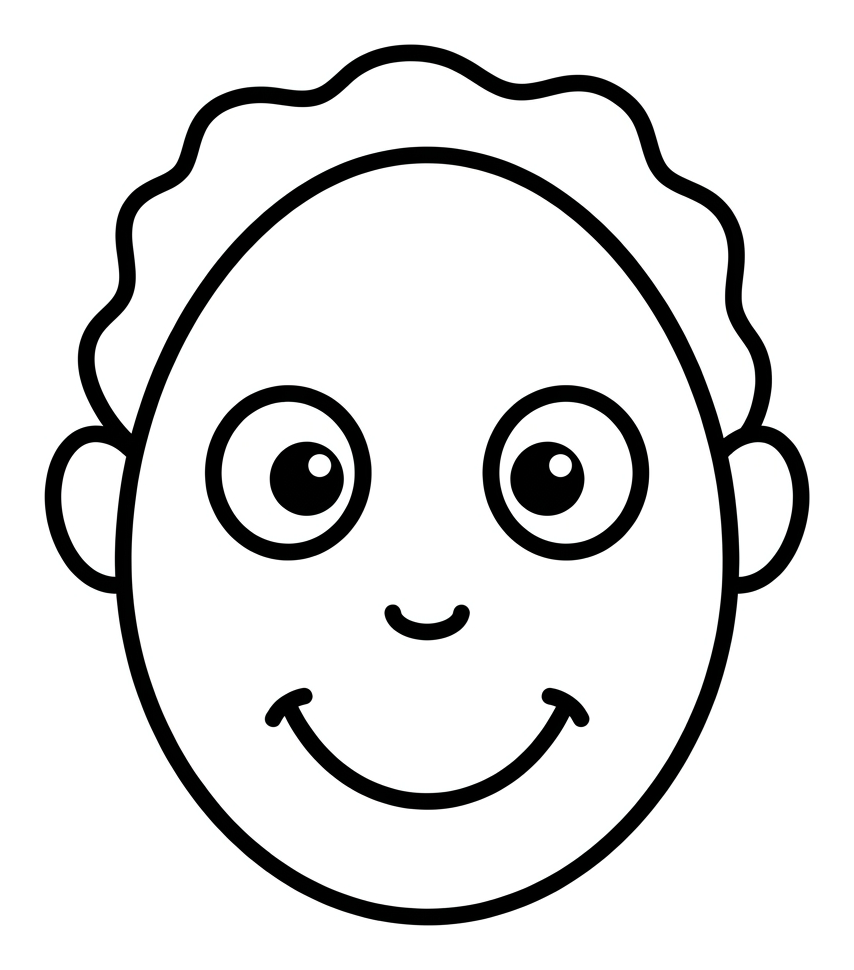
Begin by talking through the proportions together using the portrait on the sheet. It is a cartoon, so the eyes are bigger than real eyes, but they still sit near the middle of the head rather than near the top. Then work through the questions. A mirror helps: your child can check each rule on their own face, for example by resting a finger on the bottom of their nose and noticing that it lines up with the bottom of their ears. Finally, let the child colour the portrait, choosing skin, hair and eye colours that match themselves, a family member or an invented character. Colouring also asks children to look carefully at the separate shapes that make up a face.
Extending the activity
Once children understand the basic layout, they are ready to draw their own faces from scratch. A useful next step is to fold or lightly pencil a faint horizontal line across the middle of an oval and use it to place the eyes, then a second light line halfway between that line and the chin for the bottom of the nose. Encourage experimenting with different expressions by changing only the eyebrows and mouth, which shows how much feeling a face can convey with very small changes. For a cross-curricular link, children can draw a self-portrait to accompany a piece of writing about themselves, or sketch the face of a historical figure they are studying.
Linking to the KS2 curriculum
This worksheet supports the Key Stage 2 art and design programme of study, which asks pupils to improve their mastery of art and design techniques, including drawing, with a range of materials. Learning a structured approach to portraiture is a clear, age-appropriate way to develop drawing technique. It also lays groundwork for later work on proportion, observation and the formal element of shape. Teachers can record evidence of progress by keeping the completed sheet in a sketchbook alongside a freehand portrait drawn afterwards, showing how the child has applied the proportion rule independently.
Frequently asked questions
How do you teach a child to draw a face?
Start with proportions rather than detail. The most useful rule is that the eyes sit roughly halfway down the head, the bottom of the nose about halfway between the eyes and the chin, and the mouth a little below the nose. This worksheet introduces that rule with a guided portrait and short questions, giving children a framework they can reuse every time they draw.
Where do the eyes go when drawing a face?
The eyes belong about halfway down the head, not near the top as children often assume. Leaving roughly the top half of the head for the forehead and hair is what makes a drawn face look balanced and realistic.
What age is this drawing worksheet for?
It is designed for KS2 children aged 7 to 9 (Years 3 and 4), though many younger children enjoy the colouring and older children can use it as a quick proportion refresher before a portrait task.
Is the worksheet free to print?
Yes. The worksheet is completely free, needs no sign-up, and is designed to print onto a single A4 page in black and white, ready for children to colour.
How does this link to the National Curriculum?
It supports the KS2 art and design aim of improving mastery of drawing techniques and recording observations in sketch books. Learning a structured way to lay out a portrait is an age-appropriate way to build drawing skill.
Curriculum links
- Key stage 2 Art and design (statutory): 'to improve their mastery of art and design techniques, including drawing, painting and sculpture with a range of materials [for example, pencil, charcoal, paint, clay]'
- Art & Design KS2: 'to create sketch books to record their observations and use them to review and revisit ideas'
Quoted word for word from Department for Education documents: the National Curriculum in England, the EYFS framework or the RSHE guidance. Contains public sector information licensed under the Open Government Licence v3.0.
Made by The Owee education team. Updated 13/10/2026. Free to print and share.
Educational quiz app · Ages 5-10
More learning in the Owee app
Owee turns topics like this into quizzes for children aged 5 to 10, and a treehouse grows as they learn. No ads, no chat, no strangers.
- Family-friendly
- No ads
- Private
Educational quiz app · Ages 5-10
More learning in the Owee app
Owee turns topics like this into quizzes for children aged 5 to 10, and a treehouse grows as they learn. No ads, no chat, no strangers.
Scan with your phone camera
- Family-friendly
- No ads
- Private