Educational quiz app · Ages 5-10
This is what learning looks like


Educational quiz app · Ages 5-10
This is what learning looks like
No nagging required. Keep the learning going after the worksheet, with every question read aloud and Owee guiding each step.
Scan with your phone camera
- Family-friendly
- No ads
- Private
History · Colouring and writing worksheet
The Great Fire of London: Free KS1 Colouring and Writing Worksheet
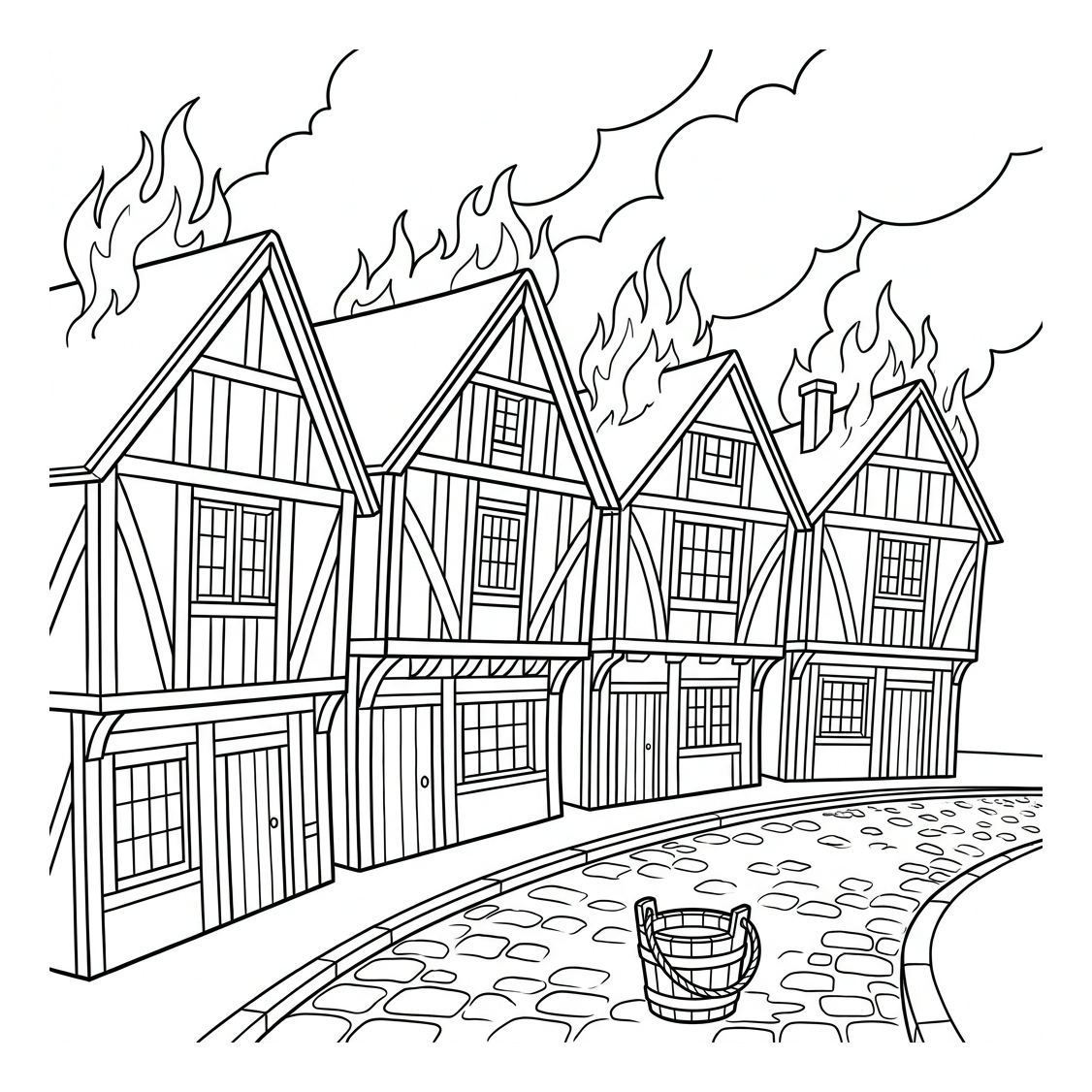
The Great Fire of London is one of the named examples in the KS1 history curriculum, and it gives young children a vivid way into the idea of events that happened beyond living memory. This free worksheet pairs a colouring picture of burning timber-framed houses with five short questions so children can practise recalling what they have learned.
It prints on one A4 page and works at home or in the classroom. The questions are deliberately simple, with a word bank to support early writers, so the focus stays on remembering the key facts of 1666 rather than on spelling.
What your child is learning
‘events beyond living memory that are significant nationally or globally [for example, the Great Fire of London, the first aeroplane flight or events commemorated through festivals or anniversaries]’
Key stage 1 History: events beyond living memory, National Curriculum in England. Source and licence

The Great Fire of London
Free History worksheet · Ages 5 to 7
Activity 1
Colour the picture of the Great Fire of London. Use these colours to help you.
- Colour the flames red, orange and yellow.
- Colour the wooden beams of the houses brown.
- Colour the smoke clouds grey.
- Colour the bucket brown.
Activity 2
Write your answers on the lines. Use the word bank to help you spell the tricky words.
In which year did the Great Fire of London happen?
On which street did the fire start?
What kind of shop did the fire start in?
What were most of the houses made of?
What did people use to blow up houses to stop the fire?
 The Great Fire of LondonSheet 95
Answers: The Great Fire of London
Sheet 95
- In which year did the Great Fire of London happen? — 1666
- On which street did the fire start? — Pudding Lane
- What kind of shop did the fire start in? — A baker's shop (a bakery)
- What were most of the houses made of? — Wood (timber)
- What did people use to blow up houses to stop the fire? — Gunpowder
For grown-ups. Free worksheets and the Owee quiz app at owee.world
Answer key
- In which year did the Great Fire of London happen? — 1666
- On which street did the fire start? — Pudding Lane
- What kind of shop did the fire start in? — A baker's shop (a bakery)
- What were most of the houses made of? — Wood (timber)
- What did people use to blow up houses to stop the fire? — Gunpowder
What happened in the Great Fire of London?
The Great Fire of London began in the early hours of Sunday 2 September 1666 in a baker's shop on Pudding Lane, owned by Thomas Farriner. A fire from the bakery oven spread to nearby buildings, and over the next four days it destroyed a huge part of the old city. By the time the flames were under control, the fire had burned more than 13,000 houses, around 87 churches and the old St Paul's Cathedral, leaving tens of thousands of Londoners homeless. The official records list only a handful of deaths, but the true number is not known. For children aged 5 to 7, the headline facts are simple: where it started (a bakery on Pudding Lane), when it happened (1666), and how big it became.
Why did the fire spread so quickly?
Several things helped the fire to spread. Most houses in 17th-century London were built close together from timber, and many were coated in tar or pitch, which burns easily. The streets were narrow, so the upper floors of houses on opposite sides almost touched, letting flames jump across. The summer of 1666 had been long and dry, and a strong east wind blew the flames towards the heart of the city. There was no fire brigade like we have today; people fought fires with leather buckets, hand-held water squirts and long hooks. Talking through these reasons helps children understand cause and effect, an important history skill, rather than simply memorising a date.
How was the Great Fire finally stopped?
The fire was halted in two main ways. People made firebreaks: they pulled houses down with fire hooks and, later, blew buildings up with gunpowder, so the flames had nothing left to burn. King Charles II and his brother James helped to organise the work. At the same time, the strong east wind finally died down, which made the last of the fire much easier to put out. Afterwards, new houses had to be built of brick and stone. The architect Sir Christopher Wren drew up a plan for a new city, which was never used, but he did design the new St Paul's Cathedral and many new churches. The Monument, a tall stone column near Pudding Lane, was built to remember the fire.
How to use this worksheet at home or school
Start by reading a short retelling of the Great Fire together, then talk about three questions: where did it start, why did it spread, and how was it stopped? Let your child colour the picture first; colouring helps many young children settle and remember details. Keep the word bank in view while they write, so children still building confidence with spelling can focus on the facts. You can also introduce Samuel Pepys, who wrote about the fire in his diary and buried his wine and a Parmesan cheese in his garden to keep them safe. His diary shows children how we know about the past. One thing to point out: in 1666 fire buckets were usually made of leather, not wood like the one in the picture.
Frequently asked questions
When did the Great Fire of London happen?
The Great Fire of London began in the early hours of Sunday 2 September 1666 and burned for around four days before it was brought under control. Because 1666 is hundreds of years ago, it is a clear example of an event that happened 'beyond living memory'.
Where did the Great Fire of London start?
It started in a baker's shop on Pudding Lane, owned by Thomas Farriner. A fire from the bakery oven spread to the wooden buildings nearby and quickly grew into a huge blaze across the city.
Why did the Great Fire of London spread so fast?
Most houses were built close together from timber and many were coated in tar, which burns easily. The streets were narrow, the summer had been dry, and a strong east wind blew the flames from house to house. There was also no fire brigade to stop it early.
How was the Great Fire of London stopped?
People made firebreaks by pulling down houses and blowing up buildings with gunpowder, so the flames had nothing left to burn. At the same time the strong wind died down, which made the last of the fire much easier to put out.
Is this Great Fire of London worksheet suitable for KS1?
Yes. It is designed for children aged 5 to 7 in Years 1 and 2, matching the KS1 history objective on significant events beyond living memory. It combines a colouring picture with simple questions and a word bank, and prints on a single A4 page.
Curriculum links
- Key stage 1 History: events beyond living memory (statutory): 'events beyond living memory that are significant nationally or globally [for example, the Great Fire of London, the first aeroplane flight or events commemorated through festivals or anniversaries]'
- KS1 History: 'develop an awareness of the past, using common words and phrases relating to the passing of time'
- KS1 History: 'ask and answer questions, choosing and using parts of stories and other sources to show that they know and understand key features of events'
- KS1 History: 'understand some of the ways in which we find out about the past and identify different ways in which it is represented'
Quoted word for word from Department for Education documents: the National Curriculum in England, the EYFS framework or the RSHE guidance. Contains public sector information licensed under the Open Government Licence v3.0.
Made by The Owee education team. Updated 13/10/2026. Free to print and share.
More history worksheets
All Year 2 worksheets →
Years 1–2 · CastlesSheet 47
Parts of a Castle
Years 1–2 · Famous peopleSheet 94
The First Moon Landing
Years 1–2 · Toys then and nowSheet 48
Toys Then and Now

Years 1–2 · TransportSheet 49
Transport Through Time
Years 3–4 · Ancient EgyptSheet 127
Egyptian Mummies and Canopic Jars
Years 3–4 · RomansSheet 167
Label a Roman Soldier
Educational quiz app · Ages 5-10
More learning in the Owee app
Owee turns topics like this into quizzes for children aged 5 to 10, and a treehouse grows as they learn. No ads, no chat, no strangers.
- Family-friendly
- No ads
- Private
Educational quiz app · Ages 5-10
More learning in the Owee app
Owee turns topics like this into quizzes for children aged 5 to 10, and a treehouse grows as they learn. No ads, no chat, no strangers.
Scan with your phone camera
- Family-friendly
- No ads
- Private