Educational quiz app · Ages 5-10
This is what learning looks like


Educational quiz app · Ages 5-10
This is what learning looks like
No nagging required. Keep the learning going after the worksheet, with every question read aloud and Owee guiding each step.
Scan with your phone camera
- Family-friendly
- No ads
- Private
Science · Labelling and colouring worksheet
Build a Food Chain: Free KS2 Science Worksheet
A food chain shows how energy passes from one living thing to the next as one organism is eaten by another. This free worksheet uses a familiar British example – grass, a rabbit and a fox – to help children in Year 4 build and read a simple food chain for themselves.
Children label each organism as the producer, the prey or the predator, work out which way the energy flows, and then colour the picture. It is designed to print neatly onto a single A4 page, ready to use at the kitchen table or in the classroom.
What your child is learning
‘construct and interpret a variety of food chains, identifying producers, predators and prey’
Year 4 Science: Animals, including humans, National Curriculum in England. Source and licence
Build a Food Chain: Label and Colour
Free Science worksheet · Ages 8 to 9
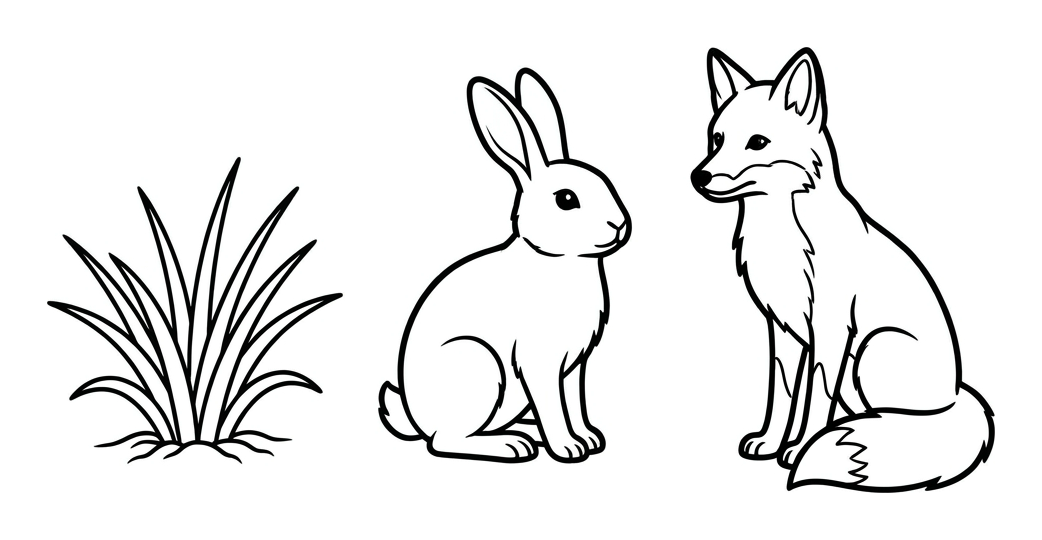
Label the food chain
Look at the three living things in the picture. Finish the first three sentences with producer, prey or predator. Then answer the questions. Use the word bank to help you.
The grass is the ...
The rabbit is the ...
The fox is the ...
In which direction does the energy flow along the chain?
Why is the grass called a producer?
What might happen to the foxes if all the rabbits disappeared?
Colour the food chain
Colour the three living things using the colours below.
- Colour the grass green.
- Colour the rabbit brown or grey.
- Colour the fox orange, with a white chest and a white tip on its tail.
 Build a Food Chain: Label and ColourSheet 152
Answers: Build a Food Chain: Label and Colour
Sheet 152
- The grass is the ... — producer
- The rabbit is the ... — prey
- The fox is the ... — predator
- In which direction does the energy flow along the chain? — From the grass to the rabbit to the fox (the arrows point towards the animal doing the eating).
- Why is the grass called a producer? — Because it makes its own food using sunlight, instead of eating other living things.
- What might happen to the foxes if all the rabbits disappeared? — The foxes would have less food, so they might go hungry, move away or fall in number.
For grown-ups. Free worksheets and the Owee quiz app at owee.world
Answer key
- The grass is the ... — producer
- The rabbit is the ... — prey
- The fox is the ... — predator
- In which direction does the energy flow along the chain? — From the grass to the rabbit to the fox (the arrows point towards the animal doing the eating).
- Why is the grass called a producer? — Because it makes its own food using sunlight, instead of eating other living things.
- What might happen to the foxes if all the rabbits disappeared? — The foxes would have less food, so they might go hungry, move away or fall in number.
What is on the worksheet
The worksheet shows a single line drawing of three living things spaced in a row: a tuft of grass, a rabbit and a fox. Underneath, a short labelling task asks children to write whether each one is the producer, the prey or the predator, using a word bank for support.
A second set of questions checks understanding: which direction the energy travels along the chain, why the grass is called a producer, and what would happen to the foxes if the rabbits disappeared. Finally, a colouring task invites children to colour the three living things, with a short list of colours to follow.
How to use it at home or in the classroom
Print the page on plain A4. Before your child starts writing, talk through what each animal eats – the rabbit eats grass, and the fox eats the rabbit – so the idea of 'who eats whom' is clear.
Encourage children to draw the chain with arrows on scrap paper first and to say each arrow aloud as 'is eaten by'. The arrow points in the direction the energy travels: from the food to the eater. Reading it backwards ('the rabbit eats the grass', so the arrow points at the grass) is the most common mistake. The colouring task works well as a calm finishing activity, and the questions make a good basis for a short discussion or a follow-up at dinner time.
What your child will learn
By the end of the sheet, children should be able to construct a simple food chain and use the correct vocabulary: producer, prey and predator. They will understand that plants are producers because they make their own food using sunlight, and that animals are consumers because they must eat other living things.
The questions also introduce the idea that living things in a habitat depend on one another, so a change to one part of a food chain affects the others. This lays the groundwork for later work on food webs and ecosystems in upper Key Stage 2.
A note for teachers
This sheet supports the statutory Year 4 'Animals, including humans' objective on constructing and interpreting food chains. It can be used as an introduction, a quick formative check, or a low-stakes recap.
The grass-rabbit-fox example is deliberately British and uncluttered so that pupils focus on the structure of the chain rather than unfamiliar species. For higher attainers, ask them to build a longer chain from another habitat, such as leaf → caterpillar → blue tit → sparrowhawk, and to say which animal is both predator and prey (the blue tit).
Frequently asked questions
What is a food chain for KS2?
A food chain shows the order in which living things eat one another, and the way energy passes along that order. A simple KS2 example is grass, then a rabbit that eats the grass, then a fox that eats the rabbit. The arrows in a food chain always point in the direction the energy flows, from the food to the animal that eats it.
What are producers, predators and prey?
A producer is a plant that makes its own food using sunlight, such as grass. Prey is an animal that is eaten by another animal, such as the rabbit. A predator is an animal that hunts and eats other animals, such as the fox. In a chain, one animal can be both prey and predator depending on its position.
Which way do the arrows point in a food chain?
The arrows always point from the organism that is eaten towards the one that eats it, because they show the direction energy travels. So in grass to rabbit to fox, the arrow points from the grass to the rabbit, and from the rabbit to the fox.
Is this worksheet free to download and print?
Yes. This worksheet is completely free to download, print and photocopy for use at home or in the classroom. It is designed to fit neatly onto one A4 page.
What age and year group is this food chain worksheet for?
It is aimed at children aged 8 to 9 in Year 4, which is lower Key Stage 2, where food chains are part of the statutory science curriculum. Confident Year 3 pupils or those revising in Year 5 may also find it useful.
Curriculum links
- Year 4 Science: Animals, including humans (statutory): 'construct and interpret a variety of food chains, identifying producers, predators and prey'
Quoted word for word from Department for Education documents: the National Curriculum in England, the EYFS framework or the RSHE guidance. Contains public sector information licensed under the Open Government Licence v3.0.
Made by The Owee education team. Updated 13/10/2026. Free to print and share.
More science worksheets
All Year 4 Science worksheets →
Years 3–4 · Food chainsSheet 153
Build a Food Chain: Label and True or False
Years 3–4 · Teeth and digestionSheet 157
Animal Teeth and What They Eat
Years 3–5 · Forces and magnetsSheet 175
Forces and Friction
Years 3–4 · Rocks and fossilsSheet 120
How a Fossil Is Made
Years 3–4 · LightSheet 118
How Shadows Are Made
Years 3–5 · PlantsSheet 119
Inside a Flower
Educational quiz app · Ages 5-10
More learning in the Owee app
Owee turns topics like this into quizzes for children aged 5 to 10, and a treehouse grows as they learn. No ads, no chat, no strangers.
- Family-friendly
- No ads
- Private
Educational quiz app · Ages 5-10
More learning in the Owee app
Owee turns topics like this into quizzes for children aged 5 to 10, and a treehouse grows as they learn. No ads, no chat, no strangers.
Scan with your phone camera
- Family-friendly
- No ads
- Private