Educational quiz app · Ages 5-10
This is what learning looks like


Educational quiz app · Ages 5-10
This is what learning looks like
No nagging required. Keep the learning going after the worksheet, with every question read aloud and Owee guiding each step.
Scan with your phone camera
- Family-friendly
- No ads
- Private
Maths · Colouring and write-the-answer worksheet
Treasure Map Coordinates: Free First-Quadrant Worksheet (KS2)
This free printable worksheet helps Year 4 children practise one of the trickier ideas in the position and direction strand: describing where things are on a 2-D grid using coordinates in the first quadrant. A friendly pirate treasure map turns abstract grid references into a purposeful hunt, which is often what makes the skill finally click.
Children start by numbering the grid lines 0 to 6 themselves, then find what is drawn at given coordinates, write a coordinate of their own, and spot a swapped pair. The most common error at this stage is reversing the two numbers, so every task reinforces the same rule: read and write coordinates in the order (across, then up). The sheet prints onto one A4 page, so it works at the kitchen table or as a quick classroom starter.
What your child is learning
‘describe positions on a 2-D grid as coordinates in the first quadrant’
Year 4 Maths: Geometry – position and direction, National Curriculum in England. Source and licence

Treasure Map Coordinates
Free Maths worksheet · Ages 8 to 9
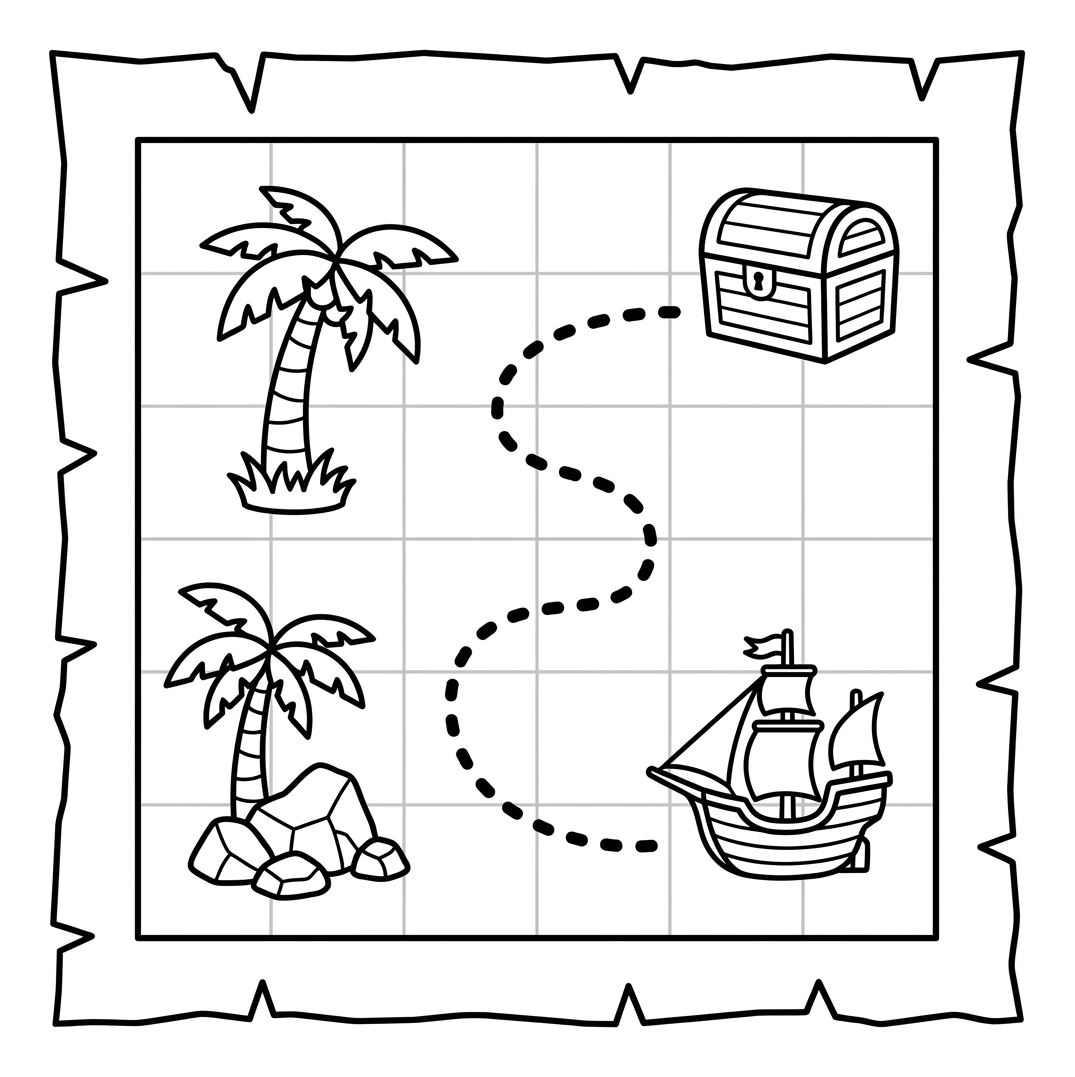
Read and write the coordinates
First number the grid lines 0 to 6 along the bottom and 0 to 6 up the side. The bottom-left corner is (0, 0). Coordinates are written (across, up).
What is drawn on the point (5, 5)?
What is drawn on the point (5, 1)?
What is drawn on the point (1, 5)?
Write the coordinates of the bottom-right corner of the grid.
Sam says the ship is at (1, 5). What mistake has Sam made?
Colour the treasure map
When you have finished, colour the map.
- Colour the palm tree leaves green and the trunks brown.
- Colour the ship's sails red.
- Colour the treasure chest yellow with a brown lid.
- Colour the dotted path in your favourite colour.
 Treasure Map CoordinatesSheet 136
Answers: Treasure Map Coordinates
Sheet 136
- What is drawn on the point (5, 5)? — The treasure chest
- What is drawn on the point (5, 1)? — The ship
- What is drawn on the point (1, 5)? — A palm tree (the top one)
- Write the coordinates of the bottom-right corner of the grid. — (6, 0)
- Sam says the ship is at (1, 5). What mistake has Sam made? — Sam has swapped the numbers. The ship is at (5, 1): 5 across, then 1 up. (1, 5) is a palm tree.
For grown-ups. Free worksheets and the Owee quiz app at owee.world
Answer key
- What is drawn on the point (5, 5)? — The treasure chest
- What is drawn on the point (5, 1)? — The ship
- What is drawn on the point (1, 5)? — A palm tree (the top one)
- Write the coordinates of the bottom-right corner of the grid. — (6, 0)
- Sam says the ship is at (1, 5). What mistake has Sam made? — Sam has swapped the numbers. The ship is at (5, 1): 5 across, then 1 up. (1, 5) is a palm tree.
What coordinates in the first quadrant actually mean
The first quadrant is the top-right section of a grid where both numbers are zero or positive, so children only ever deal with whole, positive values to begin with. A coordinate is written as a pair inside brackets, separated by a comma, such as (3, 5). The first number tells you how far to move across from the origin (the bottom-left corner), and the second tells you how far to move up. Pointing out that the lines, not the spaces, carry the numbers helps prevent the most frequent misreadings.
How to support your child or class
The reliable memory hook is "along the corridor, then up the stairs", or simply "across, then up". Encourage children to put a finger on the origin and physically trace the across movement first, then the up movement, before saying the coordinate aloud. When marking, watch carefully for reversed pairs such as (5, 3) written as (3, 5); this is rarely careless and usually means the order rule needs revisiting. Saying each coordinate as a sentence, "three across and five up", slows children down and makes the order explicit.
Why a treasure map works so well
Coordinates can feel abstract, but a map gives every grid reference a reason to exist: it marks where something is. Hunting for the palm tree, the ship or the chest gives children a genuine purpose for reading each pair accurately. The ship and a palm tree sit at (5, 1) and (1, 5), the same two numbers swapped, so a child who reverses the order lands on the wrong object and can see the mistake for themselves. This real-world framing mirrors how coordinates are later used in geography, computing and even spreadsheet cells, so the skill has a long shelf life beyond Year 4.
Where this leads next
Confident first-quadrant work prepares children for Years 5 and 6, where they plot points, reflect and translate simple shapes on a grid, and in Year 6 meet all four quadrants, using negative numbers. Securing the (across, up) order now removes a stubborn barrier later. If your child is ready to stretch, ask them to invent their own treasure features, write the coordinates for each, and then challenge someone else to find them.
Frequently asked questions
What does "coordinates in the first quadrant" mean for Year 4?
It means describing positions on a grid where both numbers are zero or positive, written as a pair such as (3, 5). The first quadrant is the top-right section of a coordinate grid, so children work only with whole, positive numbers, which keeps the focus on reading and writing the pairs correctly.
Which number comes first in a coordinate?
The across number always comes first, then the up number, so a coordinate reads (across, up). A helpful phrase is "along the corridor, then up the stairs". Reversing the two numbers is the most common mistake, so this worksheet practises the order repeatedly.
Is this worksheet free to print?
Yes. The worksheet is completely free and designed to print onto a single A4 page in black and white, so children can colour the treasure map as they work. There is no sign-up needed to download or print it.
What age and key stage is this coordinates worksheet for?
It is aimed at children aged 8 to 9 in Year 4 (Key Stage 2), matching the National Curriculum objective on describing positions on a 2-D grid in the first quadrant. Confident younger children or those needing revision in Year 5 may also find it useful.
How can I help my child if they keep mixing up the numbers?
Ask them to put a finger on the bottom-left corner and trace across first, then up, while saying the coordinate as a sentence such as "three across, five up". Slowing down and speaking the movement aloud makes the (across, up) order explicit and reduces reversed pairs.
Curriculum links
- Year 4 Maths: Geometry – position and direction (statutory): 'describe positions on a 2-D grid as coordinates in the first quadrant'
- Year 4 Geometry (position and direction): 'plot specified points and draw sides to complete a given polygon'
- Year 5 Geometry (position and direction): 'identify, describe and represent the position of a shape following a reflection or translation'
- Year 6 Geometry (position and direction): 'describe positions on the full coordinate grid (all four quadrants)'
Quoted word for word from Department for Education documents: the National Curriculum in England, the EYFS framework or the RSHE guidance. Contains public sector information licensed under the Open Government Licence v3.0.
Made by The Owee education team. Updated 13/10/2026. Free to print and share.
More maths worksheets
All Year 4 Maths worksheets →
Year 4 · Addition and subtractionSheet 134
4-Digit Column Addition
Years 3–4 · AnglesSheet 135
Acute, Right and Obtuse Angles Castle

Years 2–4 · SymmetrySheet 63
Butterfly Lines of Symmetry
Years 3–4 · Addition and subtractionSheet 96
Column Addition
Years 3–4 · Addition and subtractionSheet 97
Column Subtraction
Years 4–5 · DecimalsSheet 137
Decimals and Fractions Caterpillar
Educational quiz app · Ages 5-10
More learning in the Owee app
Owee turns topics like this into quizzes for children aged 5 to 10, and a treehouse grows as they learn. No ads, no chat, no strangers.
- Family-friendly
- No ads
- Private
Educational quiz app · Ages 5-10
More learning in the Owee app
Owee turns topics like this into quizzes for children aged 5 to 10, and a treehouse grows as they learn. No ads, no chat, no strangers.
Scan with your phone camera
- Family-friendly
- No ads
- Private