Educational quiz app · Ages 5-10
This is what learning looks like


Educational quiz app · Ages 5-10
This is what learning looks like
No nagging required. Keep the learning going after the worksheet, with every question read aloud and Owee guiding each step.
Scan with your phone camera
- Family-friendly
- No ads
- Private
Science · Colouring and short-answer worksheet
Constellations and the Night Sky: Free KS2 Worksheet
A constellation is simply a pattern that people have picked out from the stars and given a name. This free, printable worksheet invites children aged 9 to 11 to colour a night-sky scene, trace the lines that join the stars of two well-known patterns, and answer five short questions about stargazing. It works as a gentle enrichment activity alongside the Year 5 Earth and space unit.
The sheet is designed to print cleanly onto one sheet of A4 with no special equipment. It works well alongside a real evening of stargazing: print it, head somewhere away from bright streetlights on a clear night, and see how many patterns you can match between the page and the sky.
Star Patterns in the Night Sky
Free Science worksheet · Ages 9 to 11
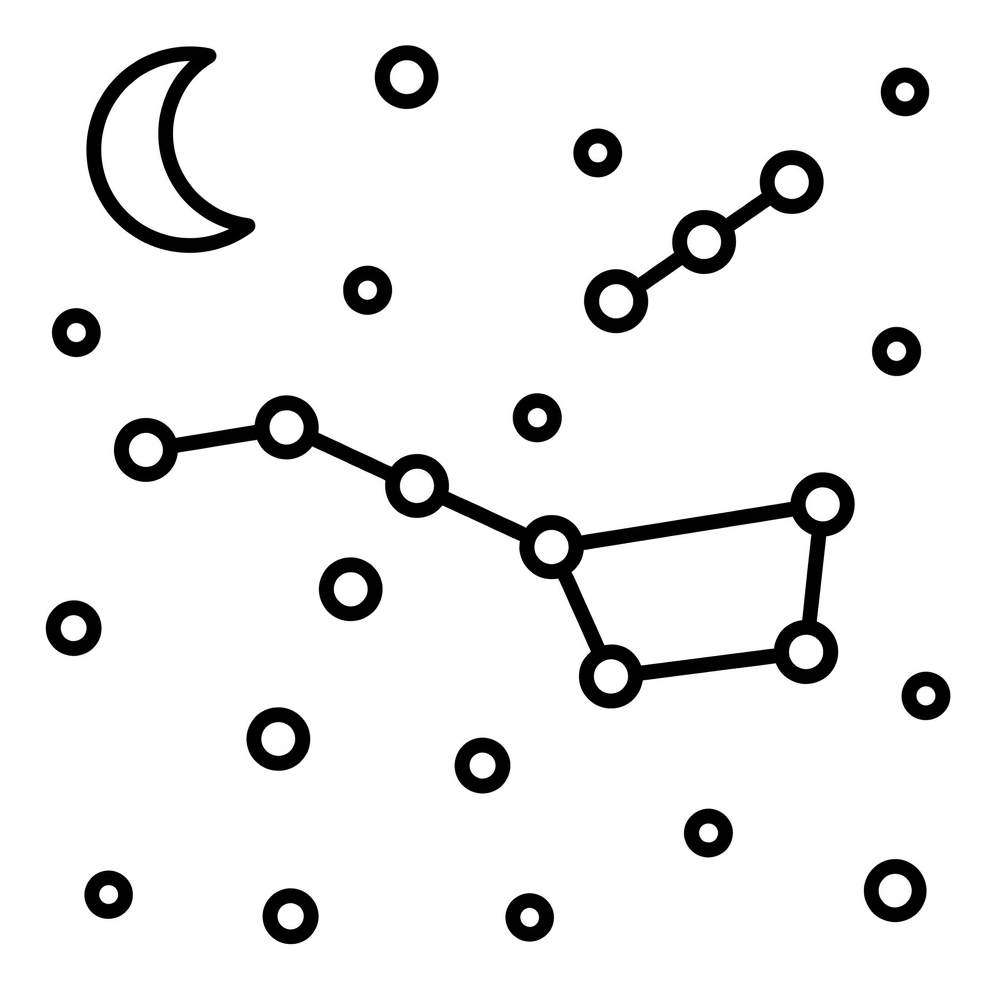
Colour the night sky
Colour the sky dark. Leave the stars and the Moon bright.
- Colour the sky dark blue or black.
- Trace the lines that join the seven stars of the Plough. Colour these stars yellow.
- Trace the line through the three stars of Orion's Belt.
- Colour the crescent Moon pale yellow.
What do you know about constellations?
Write your answers on the lines. Use the word bank to help you.
What is the name for a pattern of stars in the sky?
Which pattern of seven stars looks like a saucepan?
Which constellation has three bright stars in a row, called its belt?
What do we call the glow from streetlights that hides fainter stars?
Name one thing that helps you see more stars at night.
 Star Patterns in the Night SkySheet 173
Answers: Star Patterns in the Night Sky
Sheet 173
- What is the name for a pattern of stars in the sky? — Constellation
- Which pattern of seven stars looks like a saucepan? — The Plough
- Which constellation has three bright stars in a row, called its belt? — Orion
- What do we call the glow from streetlights that hides fainter stars? — Light pollution
- Name one thing that helps you see more stars at night. — Going somewhere dark, away from bright lights (also accept: a clear night, a night with no Moon, letting your eyes get used to the dark)
For grown-ups. Free worksheets and the Owee quiz app at owee.world
Answer key
- What is the name for a pattern of stars in the sky? — Constellation
- Which pattern of seven stars looks like a saucepan? — The Plough
- Which constellation has three bright stars in a row, called its belt? — Orion
- What do we call the glow from streetlights that hides fainter stars? — Light pollution
- Name one thing that helps you see more stars at night. — Going somewhere dark, away from bright lights (also accept: a clear night, a night with no Moon, letting your eyes get used to the dark)
What is a constellation?
A constellation is a group of stars that, seen from Earth, appear to form a recognisable shape or pattern. The stars within a constellation are usually not close together in space at all; many are vast distances apart and only line up by chance from our particular viewpoint. Cultures across the world have grouped the same stars into different pictures and stories, which is why a single pattern can have several names. The seven bright stars known in Britain as the Plough are called the Big Dipper in the United States and form part of a larger constellation, Ursa Major (the Great Bear). For children, the key idea is that we are spotting patterns in points of light, not real connected objects in the sky.
The Plough and Orion: two patterns to look for
Two patterns are especially useful for beginners in the UK. The Plough is a group of seven stars shaped a little like a saucepan or plough; it sits high in the northern sky and can be seen all year round from Britain. The two stars at the end of its 'bowl' point towards Polaris, the North Star, which is handy for finding direction. Orion (the Hunter) is best seen on winter evenings and is easy to recognise thanks to the three bright stars in a short, straight line that make up 'Orion's Belt'. Encouraging children to find these two patterns first gives them an anchor point from which to explore the rest of the sky.
Why a dark sky matters
Stars are easiest to see away from artificial light. Streetlights, car headlights and lit windows create light pollution, a glow that washes out fainter stars and makes patterns harder to pick out. The best stargazing happens on a clear, moonless night somewhere dark, such as a garden away from lamps, a park, or the countryside. It also helps to let your eyes adjust to the dark for around twenty minutes and to avoid looking at bright phone screens. This is a good opportunity to talk with children about how our towns and cities have changed what we can see in the sky.
How to use this worksheet
This sheet is enrichment rather than a statutory requirement, so there is no single 'right' way to use it. Children colour the sky dark, then trace over the lines that join the saucepan shape of the Plough and the three-in-a-row of Orion's Belt. A word bank supports the five short questions, which can be answered from the discussion above or used to start a conversation. A common mix-up is to think a constellation is a single star or a planet; asking "How many stars make the Plough?" helps children see it is a pattern. If you can, follow it up by stepping outside on a clear night to compare the printed patterns with the real sky, perhaps using a free stargazing app to confirm what you have found.
Frequently asked questions
What is a constellation in simple terms?
A constellation is a pattern of stars that people have picked out and named, such as the Plough or Orion. The stars only look grouped together from Earth; in reality they can be huge distances apart in space.
Is this worksheet suitable for Year 5 and Year 6?
Yes. It is aimed at children aged 9 to 11 (KS2 Years 5 to 6) and works as enrichment alongside the Year 5 Earth and space unit. Constellations are not in the statutory wording, but they are a natural extension of the topic.
How can children see the Plough and Orion in the UK?
The Plough is visible all year round high in the northern sky. Orion is best seen on clear winter evenings and is easy to spot because of the three stars in a line that form Orion's Belt. Choosing a dark spot away from streetlights helps.
Why are stars harder to see in towns and cities?
Artificial lights from streetlamps, cars and buildings create light pollution, a glow that hides fainter stars. Stargazing is much better in a dark place, on a clear night, after letting your eyes adjust to the dark for around twenty minutes.
Is the worksheet free and printable?
Yes. It is completely free and prints onto a single sheet of A4 with no special equipment needed. It includes a night-sky scene to colour, two star patterns to trace and five short questions.
Made by The Owee education team. Updated 13/10/2026. Free to print and share.
More science worksheets
All Year 5 Science worksheets →
Years 5–6 · Earth and spaceSheet 170
Day and Night on Earth
Years 1–2 · Earth and spaceSheet 32
Label a Space Rocket
Years 1–2 · Earth and spaceSheet 33
Meet an Astronaut
Years 5–6 · Earth and spaceSheet 171
Order of the Planets
Years 5–6 · Earth and spaceSheet 172
Phases of the Moon
Years 5–6 · Earth and spaceSheet 174
The Earth, Sun and Moon
Educational quiz app · Ages 5-10
More learning in the Owee app
Owee turns topics like this into quizzes for children aged 5 to 10, and a treehouse grows as they learn. No ads, no chat, no strangers.
- Family-friendly
- No ads
- Private
Educational quiz app · Ages 5-10
More learning in the Owee app
Owee turns topics like this into quizzes for children aged 5 to 10, and a treehouse grows as they learn. No ads, no chat, no strangers.
Scan with your phone camera
- Family-friendly
- No ads
- Private