Educational quiz app · Ages 5-10
This is what learning looks like


Educational quiz app · Ages 5-10
This is what learning looks like
No nagging required. Keep the learning going after the worksheet, with every question read aloud and Owee guiding each step.
Scan with your phone camera
- Family-friendly
- No ads
- Private
Maths · Counting and addition worksheet
Adding to 10 Worksheet: Free KS1 Maths Printable
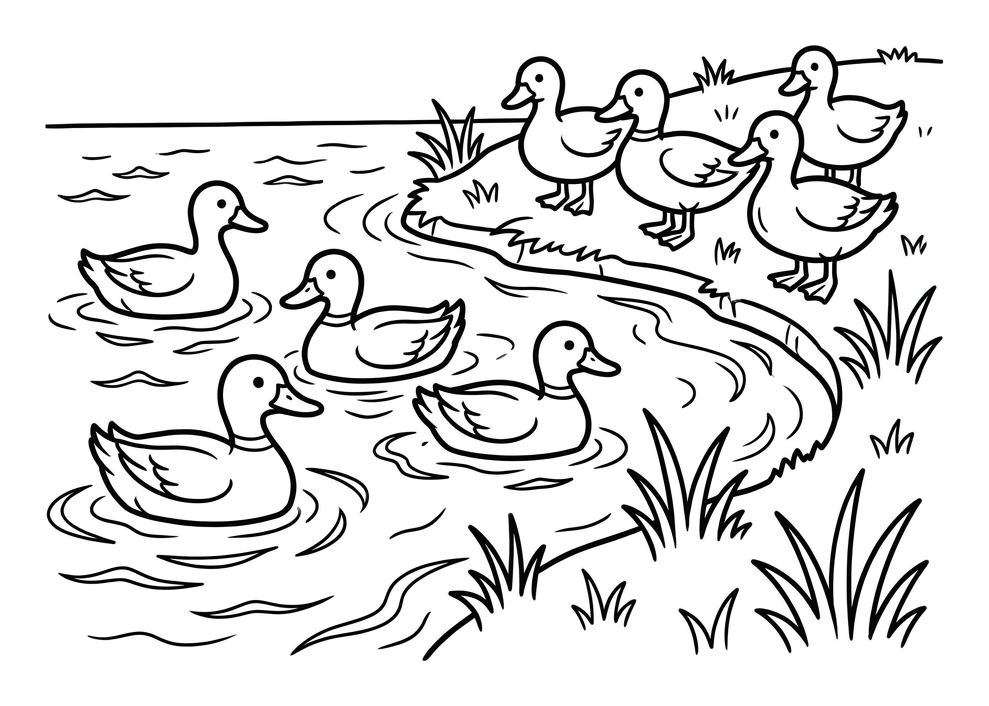
This free printable worksheet gives children in Year 1 a gentle, picture-based introduction to addition within 10. Instead of starting with abstract symbols, children count two groups of ducks in one pond scene — four swimming on the water and four standing on the bank — then work out how many there are altogether and write it as a number sentence.
It prints on one A4 page, with a line-art picture children can colour in once the counting is done. Colouring each duck as it is counted is a simple way to make sure none is missed or counted twice, a very common slip at this age.
What your child is learning
‘add and subtract one-digit and two-digit numbers to 20, including 0’
Year 1 Maths: Number – addition and subtraction, National Curriculum in England. Source and licence

Adding to 10: Ducks on the Pond
Free Maths worksheet · Ages 5 to 6
Activity 1
Look at the pond. Count each group of ducks. Write the number in the box.
- How many ducks are swimming on the water?
- How many ducks are standing on the grassy bank?
Activity 2
Now put the two groups together. How many ducks are there altogether?
How many ducks are there altogether?
Write a number sentence for the ducks. Use + and =.
 Adding to 10: Ducks on the PondSheet 12
Answers: Adding to 10: Ducks on the Pond
Sheet 12
- How many ducks are swimming on the water? — 4
- How many ducks are standing on the grassy bank? — 4
- How many ducks are there altogether? — 8
- Write a number sentence for the ducks. Use + and =. — 4 + 4 = 8
For grown-ups. Free worksheets and the Owee quiz app at owee.world
Answer key
- How many ducks are swimming on the water? — 4
- How many ducks are standing on the grassy bank? — 4
- How many ducks are there altogether? — 8
- Write a number sentence for the ducks. Use + and =. — 4 + 4 = 8
What this worksheet teaches
This worksheet supports the very first stage of formal addition: combining two groups to find a total. Children count the ducks on the water, then the ducks on the bank, and finally count them all together to reach 8. This ‘count-all’ strategy is the natural starting point for five- and six-year-olds and lays the groundwork for ‘counting on’, where a child holds the first number in their head and counts up from it. Because both groups are the same size, the picture also shows a double (4 + 4), and doubles are some of the first addition facts children learn to recall without counting.
How to use it at home or in the classroom
Begin by talking about the picture before any writing happens. Ask the child to point to and count the ducks on the water, then the ducks on the bank, touching each one as they count. The ducks on the bank overlap a little, so a light tick on each one helps avoid counting the same duck twice. Encourage them to say the two numbers aloud, then count every duck to find the total. Once they have written the answer, let them colour the scene and revisit the numbers (‘How many ducks did you colour altogether?’). For children who find it tricky, real objects such as counters, buttons or pasta shapes laid into two groups make the same idea concrete and can be done alongside the sheet.
Linking the picture to written number sentences
Once a child is confident counting the two groups, you can introduce the matching written statement: ‘4 + 4 = 8’. The National Curriculum expects Year 1 children to read, write and interpret statements involving the addition (+) and equals (=) signs, so it helps to model this alongside the picture. Saying the sentence aloud — ‘four add four equals eight’ — and pointing to each part connects the spoken words, the symbols and the ducks. There is no need to rush this; the picture and the total come first, and the formal sum is the bridge to the next step.
Where addition to 10 leads next
Mastering totals within 10 is the foundation for number bonds, addition within 20, and eventually mental and column methods in Key Stage 2. Children who are secure with combining small groups find later work with missing numbers (such as ‘5 + ? = 9’) and subtraction much easier, because they already understand how parts make a whole. Practising little and often — a few minutes of counting games, this worksheet, or everyday counting at mealtimes — tends to build confidence more effectively than long sessions.
Frequently asked questions
What age is this addition to 10 worksheet for?
It is aimed at children aged 5 to 6 (Year 1, Key Stage 1), who are beginning to add small groups together. Confident Reception children and younger Year 2 children who need a little extra practice will also benefit from it.
Is the worksheet really free to print?
Yes. The worksheet is completely free to download and print at home or in school. It is designed to fit onto a single A4 page, including the picture children can colour in.
What is the difference between counting all and counting on?
‘Counting all’ means counting every object from one to find the total, which is how most five-year-olds begin. ‘Counting on’ means holding the first number in mind and counting up from it (saying ‘four… five, six, seven’). This worksheet supports counting all, which is the natural first step before counting on.
How can I help my child if they find addition tricky?
Use real objects such as counters, buttons or toys arranged into two small groups, and let your child touch each one as they count. Counting aloud and slowly, then counting everything together, makes the idea of adding very concrete. Then change one group (take one duck away, or add one more) and ask what the new total is. Keep sessions short and praise careful counting rather than speed.
Does this worksheet match the National Curriculum?
Yes. It supports Year 1 objectives for addition within 20, including solving one-step problems using pictorial representations and beginning to read and interpret addition and equals signs.
Curriculum links
- Year 1 Maths: Number – addition and subtraction (statutory): 'add and subtract one-digit and two-digit numbers to 20, including 0'
- Year 1 Number – addition and subtraction: 'represent and use number bonds and related subtraction facts within 20'
- Year 1 Number – number and place value: 'count to and across 100, forwards and backwards, beginning with 0 or 1, or from any given number'
- Year 1 Number – addition and subtraction: 'solve one-step problems that involve addition and subtraction, using concrete objects and pictorial representations'
Quoted word for word from Department for Education documents: the National Curriculum in England, the EYFS framework or the RSHE guidance. Contains public sector information licensed under the Open Government Licence v3.0.
Made by The Owee education team. Updated 13/10/2026. Free to print and share.
More maths worksheets
All Year 1 Maths worksheets →
Year 4 · Addition and subtractionSheet 134
4-Digit Column Addition
Years 3–4 · Addition and subtractionSheet 96
Column Addition
Years 3–4 · Addition and subtractionSheet 97
Column Subtraction
Reception–Year 1 · Addition and subtractionSheet 13
Number Bonds to 10
Years 2–3 · Addition and subtractionSheet 57
Number Bonds to 100
Years 1–2 · Addition and subtractionSheet 58
Number Bonds to 20
Educational quiz app · Ages 5-10
More learning in the Owee app
Owee turns topics like this into quizzes for children aged 5 to 10, and a treehouse grows as they learn. No ads, no chat, no strangers.
- Family-friendly
- No ads
- Private
Educational quiz app · Ages 5-10
More learning in the Owee app
Owee turns topics like this into quizzes for children aged 5 to 10, and a treehouse grows as they learn. No ads, no chat, no strangers.
Scan with your phone camera
- Family-friendly
- No ads
- Private