Educational quiz app · Ages 5-10
This is what learning looks like


Educational quiz app · Ages 5-10
This is what learning looks like
No nagging required. Keep the learning going after the worksheet, with every question read aloud and Owee guiding each step.
Scan with your phone camera
- Family-friendly
- No ads
- Private
Maths · Colouring and naming worksheet
Naming 2D Shapes Worksheet: Free KS1 Shape Robot
This free, printable worksheet helps children in Year 1 recognise and name the most common 2D shapes — circles, squares, rectangles and triangles — by spotting them inside a friendly robot. Finding shapes inside a picture is a step on from naming them on a chart, because the child has to see each shape as part of something bigger.
The activity combines colouring with simple writing, so it suits children who are still developing fine motor control and early letter formation. It prints cleanly onto one A4 page, ready to use at home or in the classroom with nothing more than a pencil and some colouring pencils.
What your child is learning
‘recognise and name common 2-D and 3-D shapes’
Year 1 Maths: Geometry – properties of shapes, National Curriculum in England. Source and licence
Naming 2D Shapes: Shape Robot
Free Maths worksheet · Ages 5 to 7
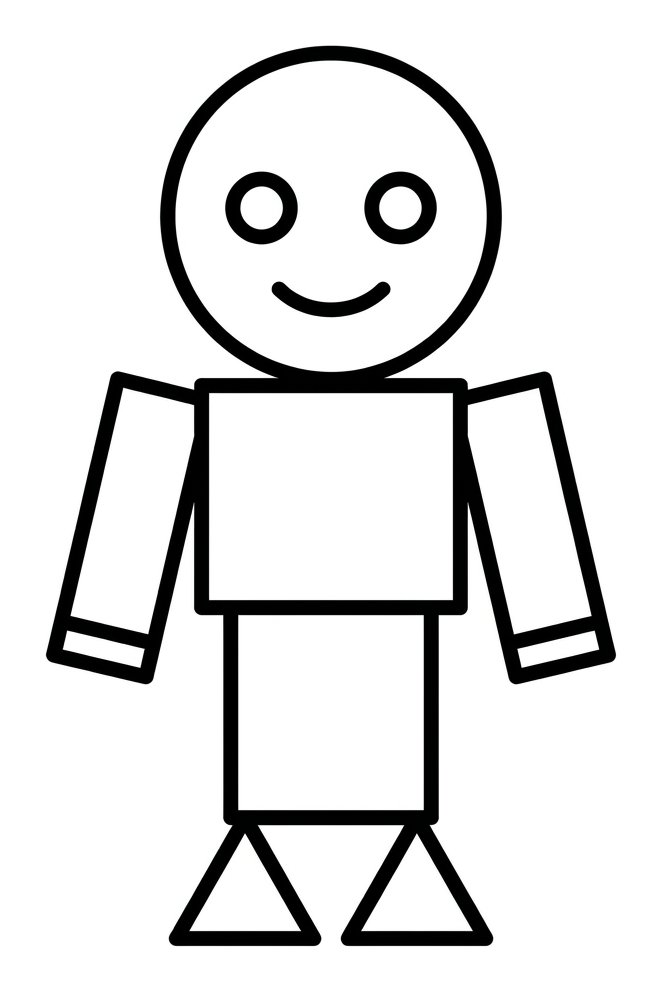
Colour the shape robot
Colour each kind of shape a different colour. Use the colour key.
- Colour all the circles yellow (the head and the eyes).
- Colour the square tummy red.
- Colour all the rectangles blue (the chest and the arms).
- Colour the two triangle feet green.
Name the shapes
Look at the robot. Write the name of each shape. Use the word bank to help you.
What shape is the robot's round head?
What shape is the robot's chest? It has two long sides and two short sides.
What shape is the robot's tummy, under the chest? All four sides are the same length.
What shape are the robot's two feet? They have three straight sides.
 Naming 2D Shapes: Shape RobotSheet 10
Answers: Naming 2D Shapes: Shape Robot
Sheet 10
- What shape is the robot's round head? — circle
- What shape is the robot's chest? It has two long sides and two short sides. — rectangle
- What shape is the robot's tummy, under the chest? All four sides are the same length. — square
- What shape are the robot's two feet? They have three straight sides. — triangle
For grown-ups. Free worksheets and the Owee quiz app at owee.world
Answer key
- What shape is the robot's round head? — circle
- What shape is the robot's chest? It has two long sides and two short sides. — rectangle
- What shape is the robot's tummy, under the chest? All four sides are the same length. — square
- What shape are the robot's two feet? They have three straight sides. — triangle
What this worksheet covers
The shape robot is built from the four 2D shapes that KS1 children meet first: the circle, square, rectangle and triangle. Its head and two eyes are circles, its chest and both arms are rectangles, its tummy is a square, and its two feet are triangles. By colouring the robot and then writing the shape names, children practise two skills at once — spotting a shape by its look and recalling its correct mathematical name. The chest and the tummy sit right next to each other, so the robot invites a useful question: what makes one a rectangle and the other a square? (The square’s four sides are all the same length.) You can also mention that a square is a special kind of rectangle, an idea that underpins later work on shape properties.
How to use it at home or in class
Start by talking through the picture together before any writing begins. Ask the child to trace each shape with a finger and describe what they notice — "this one is round all the way along" or "this one has four straight sides the same length". Counting sides and corners is a good habit to start now, even though describing shapes by their sides is a Year 2 objective; in Year 1 the main goal is naming shapes confidently. The colour key turns naming into a self-checking game: if every circle ends up yellow, you can see at a glance that the child has found them all. If you have a ruler, let them check that the tummy’s sides match and the chest’s do not. Keep sessions short and praise the reasoning, not just the right answer.
Common misconceptions to watch for
Young children often rely on orientation and size rather than properties. A square turned on its point is frequently called a "diamond", and a long thin rectangle may not be recognised as a rectangle at all. Children also tend to assume a triangle must point upwards and sit on a flat base. When you discuss the robot, deliberately point out shapes in different positions and sizes so the child learns that a shape's name comes from its number of sides and corners, not from how it is turned. This early attention to properties prevents misconceptions that can otherwise persist into Year 2 and beyond.
Where to go next
Once a child can confidently name 2D shapes in a picture, extend the learning into the real world: go on a "shape hunt" around the home, spotting circular clocks, rectangular doors and triangular roof shapes. You can then progress to comparing and sorting shapes by their number of sides, describing them with the words side, corner and curved, and eventually moving on to 3D shapes such as cubes, spheres and cylinders — all part of the Year 1 and Year 2 geometry curriculum.
Frequently asked questions
What 2D shapes should a 5 to 7 year old know?
By the end of Year 1, children are expected to recognise and name common 2D shapes including circles, squares, rectangles and triangles. In Year 2 they go further, describing properties such as the number of sides and corners and beginning to sort shapes. This worksheet focuses on the four core Year 1 shapes.
Is a square a rectangle?
Yes. In mathematics a square is a special kind of rectangle — it has four right angles and four straight sides, with the added feature that all four sides are equal in length. The National Curriculum explicitly notes 'rectangles (including squares)', so it is helpful to mention this to children, even at KS1.
How is this worksheet linked to the National Curriculum?
It supports the Year 1 geometry objective to 'recognise and name common 2-D and 3-D shapes'. Naming circles, squares, rectangles and triangles within a picture is a direct, age-appropriate way to practise this statutory aim, and it also lays the groundwork for the Year 2 work on describing and sorting shapes.
Is the worksheet free to print?
Yes. The whole worksheet is free to download and print, and it is designed to fit on a single A4 page. You only need a printer, a pencil and some colouring pencils — ideal for home learning, supply cover or a quick maths starter.
How can I make naming shapes easier for my child?
Focus on counting sides and corners rather than how a shape looks or which way it is turned. Trace each shape together with a finger, say its name aloud, and then look for the same shapes around your home. Repeating the names in different contexts helps them stick far better than memorising a single chart.
Curriculum links
- Year 1 Maths: Geometry – properties of shapes (statutory): 'recognise and name common 2-D and 3-D shapes'
- Year 2 Mathematics, Geometry – properties of shapes: 'identify and describe the properties of 2-D shapes, including the number of sides and line symmetry in a vertical line'
- Year 2 Mathematics, Geometry – properties of shapes: 'compare and sort common 2-D and 3-D shapes and everyday objects'
Quoted word for word from Department for Education documents: the National Curriculum in England, the EYFS framework or the RSHE guidance. Contains public sector information licensed under the Open Government Licence v3.0.
Made by The Owee education team. Updated 13/10/2026. Free to print and share.
More maths worksheets
All Year 1 Maths worksheets →
Years 1–2 · 2D shapesSheet 55
Naming 2D Shapes
Years 1–2 · 3D shapesSheet 11
3D Shapes Around Us
Reception–Year 1 · Addition and subtractionSheet 12
Adding to 10: Ducks on the Pond
Years 1–2 · CountingSheet 14
Count in 2s: Pairs of Wellies
Reception–Year 1 · CountingSheet 1
Count the Minibeasts
Reception–Year 1 · CountingSheet 15
Count to 20: Ladybird Spots
Educational quiz app · Ages 5-10
More learning in the Owee app
Owee turns topics like this into quizzes for children aged 5 to 10, and a treehouse grows as they learn. No ads, no chat, no strangers.
- Family-friendly
- No ads
- Private
Educational quiz app · Ages 5-10
More learning in the Owee app
Owee turns topics like this into quizzes for children aged 5 to 10, and a treehouse grows as they learn. No ads, no chat, no strangers.
Scan with your phone camera
- Family-friendly
- No ads
- Private